Harry Potter Appears Real at Warner Bros. Studio

IMG_7132
Hogwarts stairway and portraits at the Warner Bros. Studio in Leavesden, England

When I first read the Harry Potter books I found myself imagining the characters and the magic, and of course Hogwarts, but many aspects were fuzzy. That is, until I watched the first film. Suddenly the actors cast became what I saw in my head when I read the dialogue. The details were beautifully filled in by the elaborate costumes and props.

IMG_7195
The lounge of Number 4 Privet Drive is filled with Harry’s letters.

Sometime after the movies began debuting, I was in Chicago and there was a special exhibit of the Harry Potter film props and costumes. I loved it so much I was even inspired to copy the knitted blanket on Ron Weasley’s bed. I had toured movie studios and I knew that seldom do they spend so much time or money on getting to this level of reality!
IMG_7123
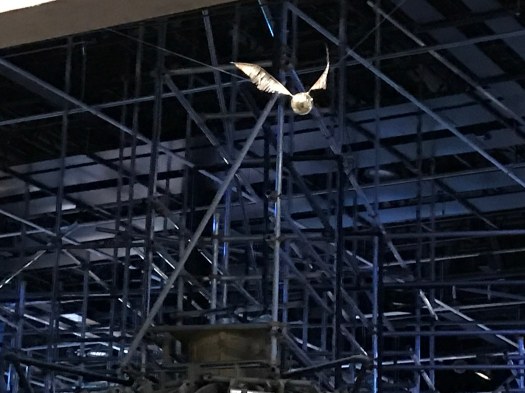
Ask at the information booth for the Passport so you can get stamps along the way and find the golden snitches throughout the tour. 

So when we were planning our Harry Potter adventures in London, I was enthusiastic about taking the train to the outskirts of London to the Warner Bros. Studio in Leavesden for the “Making of Harry Potter” tour. It is around $60 a person for a ticket to enter the world of Hogwarts, Diagon Alley and No. 4 Privet Drive. The greeter tells you that it takes about 3.5 hours to walk through (at your own pace) with a lunch stop about 2/3 through. In fact, we explored most of the sets and exhibits and stopped for a quick lunch and it took about 5.5 hours. Not that we are complaining! Plus there is shopping at the end of the tour.


IMG_7226
The graphics firm designed 20,000 individual props for the Weasley’s joke shop on Diagon Alley.

We got some great advice: ask the interpretive hosts if they have a favorite fun fact for the room they are stationed. All of the hosts were very enthusiastic about all things Harry Potter and usually gave us more than one fun fact. This is how we learned that 17,000 wand boxes were created for Olivander’s wand shop. And that many of them are still charred from the scene when Olivander’s shop explodes–a shot they only had one chance to capture. Or that Rupert Grint who played Ron asked to keep the number 4 from the house on Privet Drive.

We went on a weekday and there were lots of school trips. The staff said it is actually less crowded on the weekends. It was a fantastic day.

Discover Sculptures at Donum Winery

img_6426
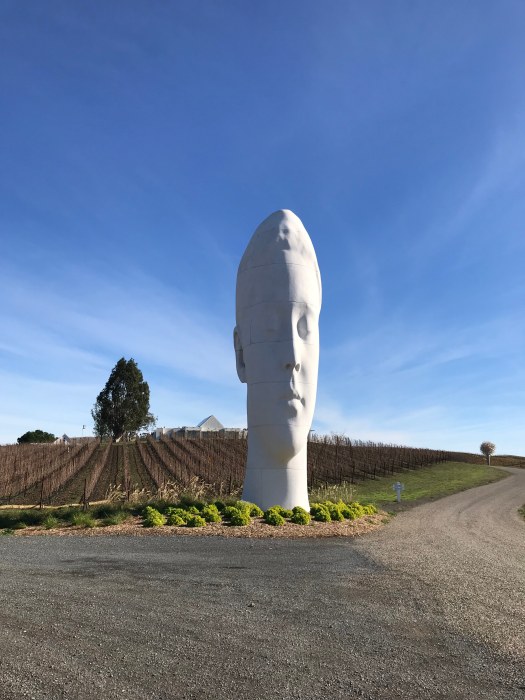
Jaume Plensa’s Sanna greets you at the entrance to the winery property.

We discovered the Donum Winery through their sculptures. My friend Cameon found an article in Artnet News that described the sculpture “park” opening soon (published in September). Cameon committed to figuring out how we could go as our adventure to celebrate my birthday at the end of November. We learned access to the sculpture gardens is through a tasting. And Donum has a limited number of tastings each day.

img_6399Donum Winery is in the Carneros region on the edge of Napa County and the San Pablo Bay. It was started as a premium winery made from the grapes the winemaker grew on vineyards in Sonoma and Mendocino counties. Burned out after a few years, the winemaker was looking for a buyer. An art collector, Allan Warburg, made an offer on the condition that the winemaker stay on and continue her craft.
img_6396

The Donum label celebrates each new year with Ai Weiwei’s image for that year (think Chinese animal). The wines are yummy. The sculptures are superb.

Most people think of a winery primarily as a place to go for a tour and a tasting. Been there done that, again and again. My friend Cameon and I are now fairly picky about what wineries we’ll go to for a tasting. The price of tastings has increased as well (Donum charges $80 a person but offers special pricing on wines.) Especially since wine aggravates my fibromyalgia so I’m only willing to do it if there is something more.

img_6410
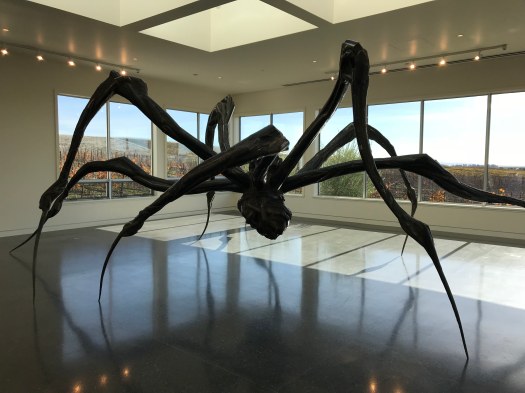
Warburg built a building just for Louise Bourgeois’ Crouching Spider.

Warburg has great taste in wine and art. I will go again when the ground is dry so I can see more of the sculptures. By then I’m pretty sure there will be even more installations!


Local Dubliners Recommend

IMG_6160While dining on stew at O’Neill’s pub, a couple of local Dubliners made some recommendations. I was thinking aloud with my son about what I was going to do in the afternoon considering I have seen most of the popular destinations at least a couple of times. I took up both of their suggestions.

First I walked to St. Stephen’s Green to see the temporary exhibit of the World War I soldier. “The Hauntings Soldier” is the creation of Martin Galbavy with the assistance of Chris Hannam. The sculpture is made from scrap metal items like horseshoes and spanners. It is really quite moving and I was especially impressed to see how many people were on site to take it in.

Then I walked to the other side of Dublin–to Parnell Square–to see the Francis Bacon studio (recreated) at the Dublin City Gallery The Hugh Lane. The studio walls could use a fresh coat of paint. I walked all the way through the galleries (tiptoeing past a concert in the middle gallery). The exhibit with the Francis Bacon studio begins with a David Frost interview with the artist on a loop. Chaos fed his creativity. Then you walk up to a window into the recreation of his London studio and see why he is so very creative.

IMG_6183
It looks like a tip, yet he created beautiful modern paintings.

“The Hauntings Soldier” may not be there when you go to Dublin, but the Francis Bacon studio will be. Go!

Lynching Memorial Focus of Civil Rights Crawl

This was the main purpose for our trip to Alabama.

IMG_5377
Slavery sculpture by Kwame Akoto-Bamfo 

History, despite its

wrenching pain, cannot

be unlived, but if faced

with courage, need not

be lived again.

–Maya Angelou

The way to right wrongs is to turn the light of truth upon them.

–Ida B. Wells

Thousands of African Americans are unknown victims of racial terror lynchings whose deaths cannot be documents, many whose names will never be known.

They are all honored here.

IMG_5383The only way to end the legacy of domestic terrorism is to remember, confront our part, and learn. The National Memorial for Peace and Justice remembers the 4,000 documented lynchings in the United States from the end of Reconstruction to the 1950s. Also called the Lynching Memorial, it is a sacred space with sculptures and a courtyard that evoke emotions of sadness, anger and thirst for justice.

Every county with one or more lynchings has a permanent memorial placed in by state  and county in alphabetical order. There are docents who can help you find a particular county, or in our case, to research if there was a lynching in California. There was one county for California represented: Kern County (Bakersfield in the San Joaquin Valley).

Hundreds of black men, women, and children were lynched in the Elaine Massacre in Phillips County, Arkansas, in 1919.

Bird Cooper was lynched in Claiborne Parish, Louisiana, in 1908 after he was acquitted for murder.

Dozens of men, women, and children were lynched in a massacre in East St. Louis, Illinois, in 1917.

IMG_5375The Legacy Museum gives more detail and a timeline of the lynchings. Through a multi-media presentation of historical accounts of lynchings, the Legacy Museum carries the story through to the new method of terror, mass incarceration.
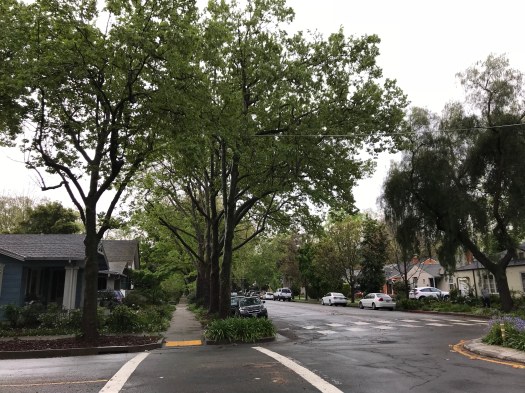
The tickets to the Memorial are $5 per all persons (children under 6 free); $8 for EJI’s Legacy Museum and a combined ticket of $10 per person. There is plenty of parking near the Memorial and a shuttle between the Legacy Museum and the lynching memorial. We thought there might be crowds on the Thursday in October and bought our tickets in advance. This probably is no longer necessary as it has been open for over 6 months. There is a security check at both locations. EJI hosts a gift shop next door to the Legacy Museum.


When Your Hometown Is Suddenly Discovered as a Destination

IMG_4150
Sacramento is the City of Trees even if some boosters are trying to make it the “Farm to Fork” capital. Tree lined streets make our city more livable in the height of 100+ degree summer days.

I’ve lived in Sacramento most of my life. For the first 25 years everyone was content with being the Capitol and a rapidly growing suburban county. As Sacramento-native Joan Didion called it, people had a more mid-western sensibility about their wealth and well-being. Our problems were either hidden or denied. The community was segregated with waves of white flight out of South Sacramento to the burgeoning suburbs.

Our claim to fame was that we were “close to everything.” It was a great place to stop if you were on your way to Tahoe, or Napa, or San Francisco or Yosemite. Sacramento is at the confluence of two great rivers–the Sacramento and American–and a gateway to the Delta, but it’s attraction for the longest time was it was at the confluence of two great highways–Interstate Highways 5 and 80.

IMG_5163
Sacramento has long enjoyed a vibrant artists community. Every year more murals are added in Midtown and Downtown. 

People in the community liked that it was a less expensive, quieter place to raise children. People would complain about “the traffic” that wouldn’t register on the Los Angeles traffic meter. We also don’t have to worry about earthquakes and our floods appear to be managed for now.

IMG_3728
Local artists Suzanne Adan and Michael Stevens created Kit & Kaboodle, an exhibit for kids at the Crocker Art Museum. The Crocker is very kid friendly, and has a great cafe for adults.

The developers who ran local politics began to beat the drum for putting Sacramento on the map and making it a world class city. In the mid-eighties they had a lot of new houses to sell in Natomas, so land speculators and builders began the dubious proposition of making Sacramento famous by bringing a professional sports team to town. The Kansas City Kings basketball team arrived in 1985 to great fanfare and a new stadium in Natomas. It did raise Sacramento’s profile but it also gave other cities opportunity to mock us for being a Cowtown.

IMG_5186
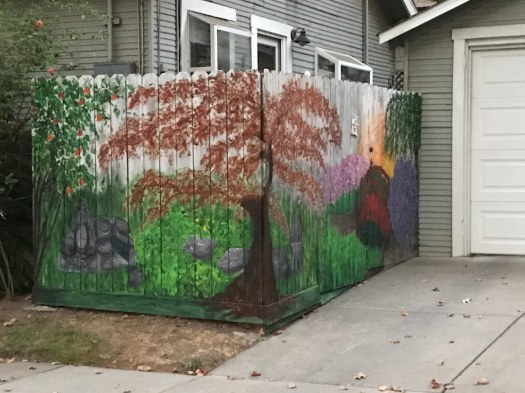
My neighbor created this on her fence and I love it!

Periodically ever since, someone–a mayor or other city booster–declares Sacramento a destination. Self-declaration doesn’t count. In the travel world you have to be anointed a destination by the Conde Nast magazines. Or the New York Times travel editor. Preferably both.

IMG_4409
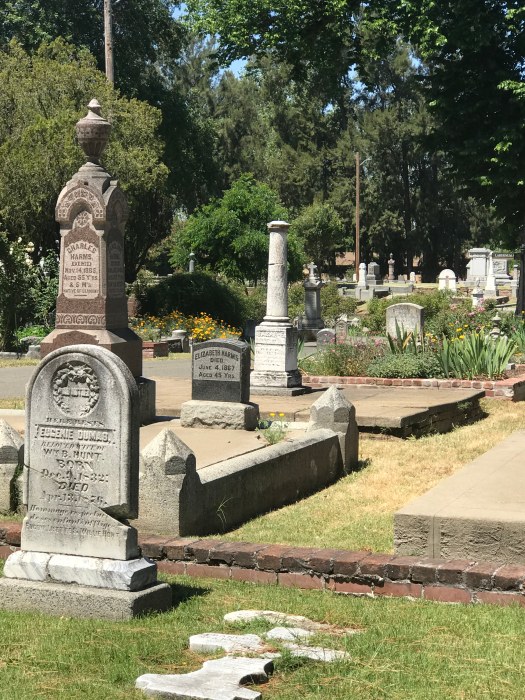
Sunset Magazine and other publications don’t mention the cemetery, but the Old City Cemetery of Sacramento is beautiful and fascinating. Docents offer a wide range of tours.

At last, thanks in large part to the spotlight that Sacramento-native Greta Gerwig shone on our fair city, Sacramento is getting the attention that some would say is long overdue. The New York Times recently released “36 Hours in Sacramento“!  It is so weird to read about the places you eat or shop regularly as destinations. Lovely too.

Once in my first professional job after grad school, the National Geographic hired our little think tank at UC Davis to review an article they were doing on the Great Central Valley. We looked at their map and shook our heads. They had Gilroy on the west side of the Valley. There were other errors as well and they didn’t correct all of the mistakes we identified for them. It made me skeptically at National Geographic maps ever since.

I love the 36 Hours series, but now having read the writer’s suggestions that would have you crisscrossing all over Sactown, I am going to refer to the 36 Hour recommendations but take the schedules with a grain of salt.  Thanks for the shout outs for local favorite restaurants and shopping destinations. We have always had a vibrant arts community and now more people are taking notice.

Sacramento has also been in the news lately because of the police shooting of an unarmed black man. Stephon Clark’s death has tested our community and revealed some problems many would rather ignore. We also have a serious homelessness problem. It appears the city council and county supervisors may finally be ready to deal with the issue. Hopefully we will begin to reform the inequities so we can truly achieve “great” status.


Chalk It Up! in Sacramento

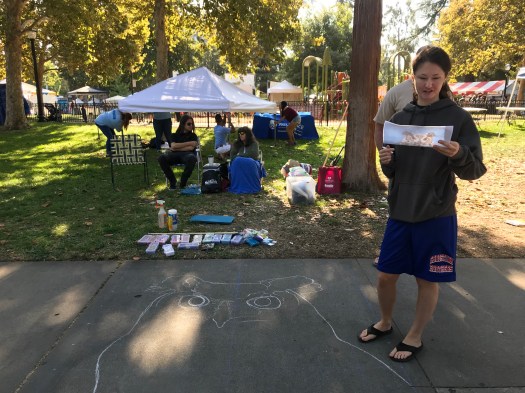
This weekend was the 28th annual Chalk It Up! at Fremont Park in Sacramento. Each Labor Day weekend, hundreds of artists invest a lot of chalk, sweat and creativity into a square on the sidewalk. Most of the mini murals have various sponsors. One artist drawing cartoon characters on the sidewalk also signed up for a double square for a dental group. He was going to draw Austin Powers with his goofy teeth before and after dental work.

People create art with a message or just for the beauty of it. There is also food, crafts and other vendors along the middle walkways. There are also many restaurants within a block of the park including Starbucks, Hot Italian, Magpie Cafe, and others. It can be a challenge to find parking, so consider riding one of the region’s red Jump bikes or walking to 15th and P from anywhere downtown.

2f2f48ee-85df-497d-96a3-9b0eaf24ff94

There is a kids zone for them to draw with chalk., plus a playground in the park.

IMG_5157

Chalk It Up promotes and supports Youth Arts by offering small grants to K-12 classrooms, and youth arts organizations throughout the Sacramento region. We do this in large part with our annual Chalk It Up! Festival which encourages artistic expression of all kinds through a three day celebration of chalk art, live music, and regional food and craft vendors.

Check Out Boston Public Library

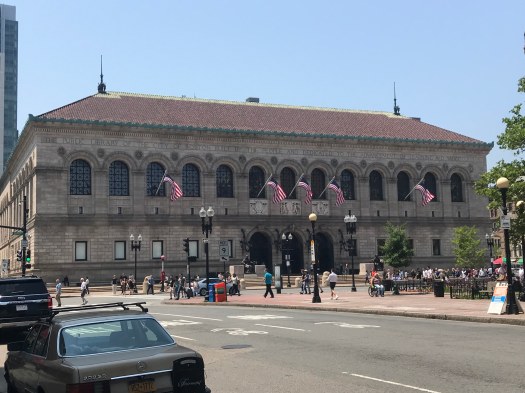
IMG_4707People rarely put a city’s central library on a list of must sees. The New York Public Library reading room is an obvious exception, and the Library of Congress is in a class by itself. So when my waitress at Cafe G at the Isabella Stewart Gardner Museum urged me to check out the Boston Public Library and take the tour offered once daily, I listened.

Fortunately admission is free and the tour is also free. This is a theme at the Boston Public Library. “Free For All” is carved in stone over the entrance. The Boston Public Library is the first large library in the nation. It was remarkable that the founding donors who started with a few rooms of books to lend in 1848 opened it to all–even the hordes of Irish and German immigrants who crowded the city at that time.

The Central Library building on Copley Square occupies a full city block. It has occupied this third home since 1895. They spared no expense on the art and architecture, hence the value of a tour from a well-trained docent like Gail. We met in the front foyer and the tour covered a lot of ground from outside the entrance to the third floor galleries to the inner courtyard. It was wonderful to learn more about the politics and controversy that gave us such a beautiful community asset.

Gail explained the blanks on the John Singer Sargent gallery, but only alluded to some conflict that prevented us from seeing the Whistler paintings in the Reading Room. It is all very interesting and worth the investment of an hour.

I also arrived early and enjoyed lunch at the Map Room Cafe. The food is all “to go” so I took my yummy Cobb salad to the nearby courtyard and enjoyed a wonderful dining experience next to the fountain. There is also a Newsfeed cafe in the new modern addition where you’ll find the Children’s Library on the second level. Or you can pay $40 per person and go all out for high tea at the Courtyard Restaurant.

Copley Square has a lot going on. The John Hancock tower is nearby. The Old South Church is the other side of Boylston Street from the library. Also straddling Boylston at the modern library entrance is the Boston Marathon finish. This is also the site of the Patriots Day bombing. Thankfully the area has fully recovered.

One block away is Newbury Street, the main shopping street of the Back Bay neighborhood. Boston is a small big city and it doesn’t take long to walk to Berklee College of Music and the Boston Museum of Art or on to Boston Public Garden.

Swatch: Bead + Fiber

IMG_4659If you find yourself in the South End of Boston and you want to mooch around a bead store or yarn shop you can satisfy both urges at Bead + Fiber. It is walking distance from the Boston Convention and Exhibition Center or Tufts Medical Center. It is also in heart of SoWa Arts Center. I discovered it while enjoying the Sunday open market.

IMG_4658I walked in and was offered a giant bone from the shop dog. Quickly someone asked if I minded dogs. Of course not. By the time I left there were three dogs between customers and the shop keepers. I love it.
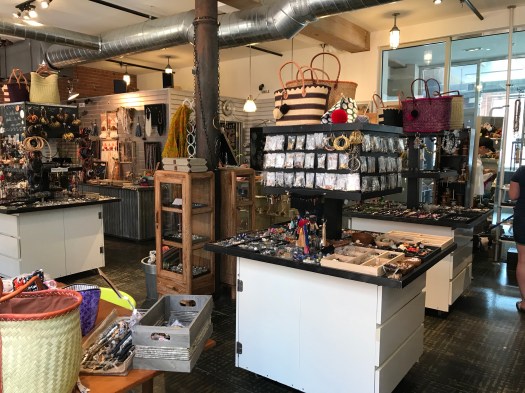
IMG_4657There was a lot to look at and the shop offered a/c on a 90 degree day with 50% humidity. I love it.
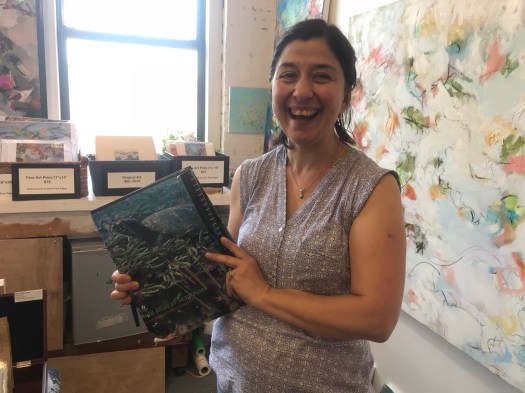
Meet the Artist Nedret Andre

IMG_4666
Nedret Andre with the Book that inspired her work focused on sea grass: World Atlas of Seagrasses.

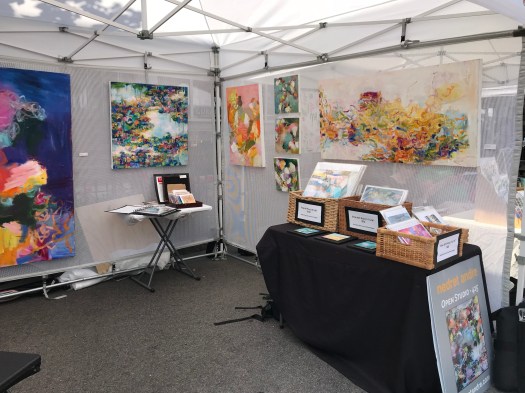
On Sundays the SoWa Art + Design District in South End Boston hosts an Open Market. I didn’t know what to expect, so I followed my muse. There are food stalls but we had just eaten a great brunch at Worden Hall. Instead I headed to the tents where makers were selling their creations. I paused at one of the stalls with art by Nedret Andre, the colors and abstractions really spoke to me. Her assistant encouraged me to meet the artist at her studio on the 4th floor of 450 Harrison Street.


I worked my way through the market checking out the whimsical art of Mitra Farmand then admiring the print works of Goosefish Press. Finally I beat a retreat to the air conditioned multi-story building of art studios. I took the elevator to the 4th level and sought out studio 415.

Nedret Andre was in her studio. She stood amidst the large canvases beautifully filled with paint and imagination. Her work is all based on the abstraction of sea grass. And before you roll your eyes, appreciate how much she has learned about the ecological importance of sea grass in the New England seashore ecosystem. Nedret’s paintings reveal a world we don’t think much about and hopes to spark our curiosity to learn more about our interdependence with the ocean.

IMG_4662We had a fun conversation with another Julie who stepped into the studio at the same time as me about the menacing green crabs–an invader from Europe who roots up the sea grass. Should we celebrate the intrinsic beauty of the green crabs even though they are destroying the ecosystem for lack of predators?
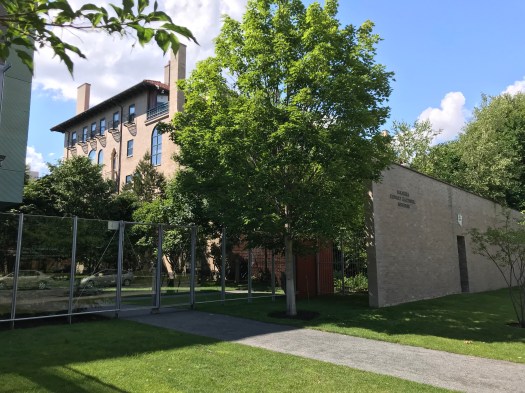
Nedret has shown her work at many galleries and often collaborates with scientists to give them an opportunity to share their expanding knowledge at the art show openings. You can also learn more on her blog at http://www.nedretandre.com. Or follow her on instagram @nedretandre.


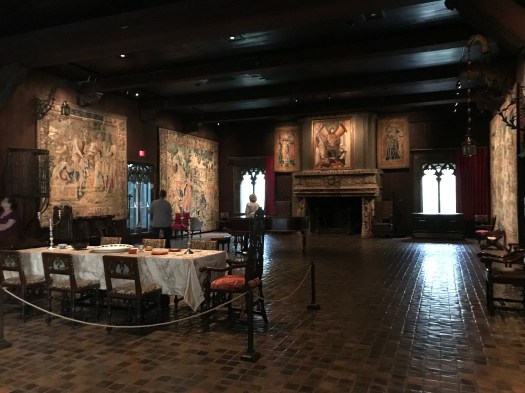
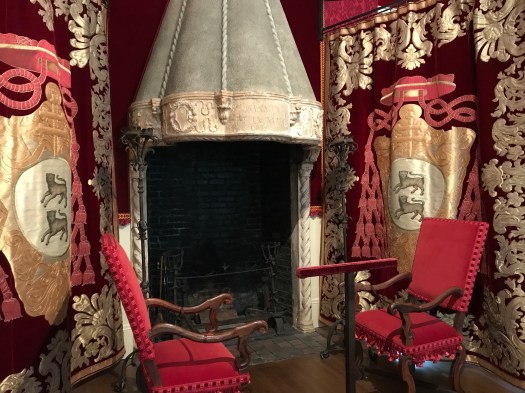
Designing Woman: Modern Tips from a Turn of the Century Woman with Impeccable Taste

IMG_4635 The first time I visited the Isabella Stewart Gardner Museum I went on the guided tour. It was like taking information in from a firehose and there wasn’t time to pause and stare at your favorite bits. So much of the museum is about the atmosphere Gardner created. I wholeheartedly recommend the tour, and I am glad I was able to return and spend a couple of hours on my own.

Isabella Stewart was born in New York City in 1840 and moved to Boston when she married her husband Jack Gardner at age 20. She inherited her father’s fortune and began collecting art. Her friend Bernard Berenson helped her pick up some magnificent Italian Renaissance art from Venetian royalty experiencing hard times. She began designing a Palace to house her collection with exquisite attention to detail. It is located in Fenway and you gain admission with just $15.

When I looked back at my photos (non flash photography is allowed) at days end I realized that I was taking more pictures of decorating ideas that I was of the most renowned pieces. (Check out  January 25 blog). Here are the top 8 design tips:

IMG_4626
Gardner’s private entrance
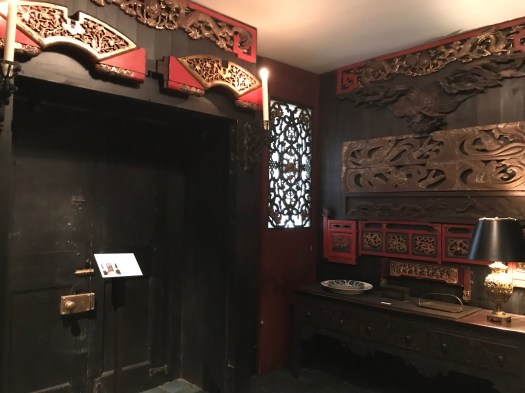
  1. Make the most of first impressions. Don’t let your foyer become just a shoe dumping ground.

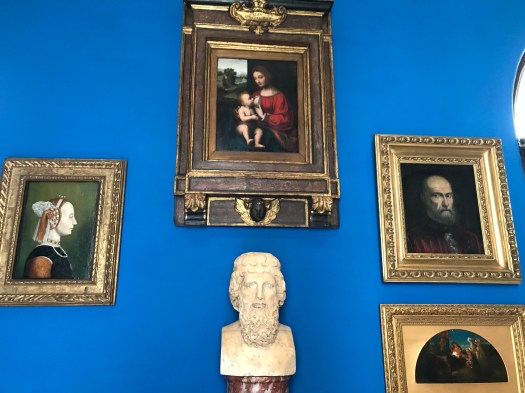
IMG_46212. Paint at least one wall “zappy blue”. The last paint color that inspired me was Jefferson’s choice of robin’s egg blue in Monticello. This is even more exciting. Gardner created the recipe and sent it to Italy to be mixed. I wonder if my local Sherwin  Williams can recreate this.
IMG_4623
The summer light is harsher on the collection–everything appears a little dustier and worn than in winter.

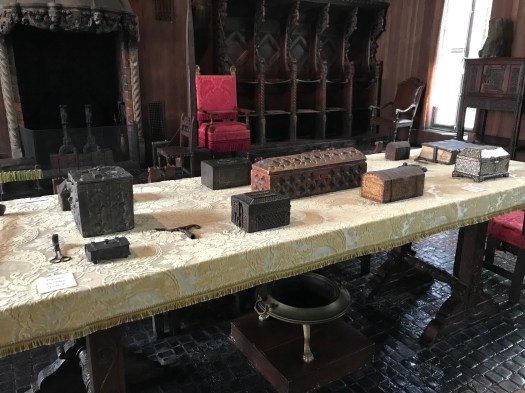
3. Take your objects d’art out of the cupboard and dedicate a sideboard or table to displaying them.

IMG_4615

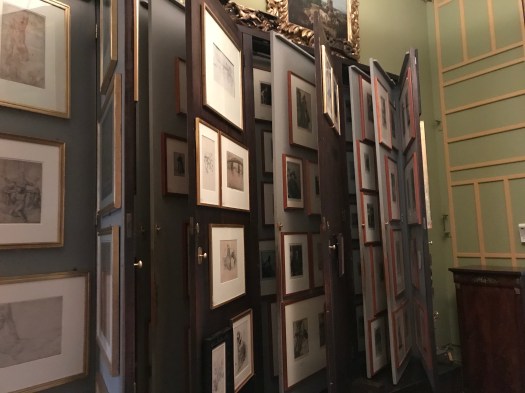
4. Add walls or doors when your art collection outgrows your display capacity.


IMG_4608

5. Find clever space for bookshelves on top of hallways and doorways.

IMG_4617

6. Take your “great room” to the next level. I once went to a fundraiser at the Governor’s Mansion that the Reagans built but Jerry Brown refused to occupy. It’s owned by a couple who filled every square inch with furniture. This sparse version (and only half is in photo) feels so much more grand.

IMG_4618

7. Build around a courtyard. I’m creating this out of my postage stamp backyard.

IMG_4614


8. Create a snug. Room too large to be cozy? Use fabric to create a room within a room.

And remember good design is timeless.