“Penguin Professor” Must Read on Penguin Awareness Day

penguin-professor-2

When I was in Auckland in November, my friend Barbara and I dashed down to High Street to the incomparable Unity bookstore. I really didn’t have room in my luggage for more books–but when has that stopped me from browsing? I purchased a couple of books including a pocket-sized one called F*ck*ing Apostrophes for a friend. Then Barbara spied the Penguin Professor and knowing my interest pointed it out. Without even reading a paragraph to see if it was dull as toast or not, I purchased it and hauled it home.

I am thrilled to say it is a wonderful book. I learned new things about penguins and Antarctica. Each chapter begins with a brief Adelie penguin snapshot–from a penguins point of view. Then one of Lloyd Spencer Davis’ stories about his accidental penguin research career and then a profile of a colleague or mentor who deserves to share the title of “Penguin Professor.” Most of his adventures are set in Antarctica, so if that locale fascinates, you will find this book hugely satisfying even if you are not crazy for penguins.

spencer-davis

Wait! This post is to celebrate Penguin Awareness Day. Let me share some of the gems from his book. His early research in 1977 and early 80s helped to dispel the idea–at least within the science community–that penguins mate for life. They do not. Although he gives a good explanation of how this misinformation took hold in the popular imagination. Furthermore, the male Adelie penguins are not the initiators in the game of love: “Ultimately it is the females, however,that decide whom to mate with and whether a male can mount them. The fights observed within Adelie penguin colonies at that time of year had traditionally been seen-in the blokey way of science up to the 1960s and the women’s liberation movement–as males fighting with each other for access to females, as if the females were somehow the spoils of war. Our observations showed, to the contrary, that the fights were often female against female.” (p 116)

Spencer Davis is a good raconteur and the chapters fly by. He pays tribute to Bernard Stonehouse as his role model in popularizing science. Storytelling is a skill that seems to come naturally but actually takes practice and Spencer Davis has practiced. He also  introduced me to the Antarctic “classic” The Worst Journey in the World.

I highly recommend Professor Penguin. He has also authored an award-winning children’s book to raise awareness about penguins: The Plight of the Penguin.

Lloyd Spencer Davis: Professor Penguin (Random House New Zealand, 2014. 185 pages paperback, $__NZ) ISBN: 978-1-77553-725-0. This delightful book chronicles Professor Lloyd Spencer Davis’ adventures studying Adelie penguins in Antarctica. His storytelling abilities shine through combined memoir, light scientific information, and tribute to his penguin-expert colleagues. Available in USA as Kindle only for $16.99.

He has also authored a children’s book to raise awareness about climate change and how it is impacting penguins: The Plight of the Penguin.

Stocking Up on Fav New Zealand Products

tiora-tea
TiOra.co.nz

Whenever I leave New Zealand I make a plan in my head for a return visit, Lord willing. I also stock up on my favorite NZ products. The Dove roll on deodorant is better here, not sure why. I also bought a number of Lynley Dodd children’s books for my newborn grandson. Finally I bought manuka honey. It is a lot more affordable to buy it here than in the USA.

Manuka honey doesn’t taste distinct from other honey, but it has terrific medicinal properties. The Maori have long known the medicinal qualities of the manuka plant and of honey from bees collecting manuka pollen. In 2006 German scientists isolated the property that gives it antibacterial properties (methylglyoxal). I use a little every morning on my toast or in a bit a of tea if I’m feeling under the weather. The amounts are probably not enough to be more than a placebo effect. Nonetheless, I like to have some on hand.

Bees generally collect from one type of flower rather than sample many types. Manuka grows in groves (like manzanita or gorse) and once they start collecting the bees are able to recognize and return to the same flowers by sight and smell. Once the hive is committed to the manuka flower the bees use dance to communicate to the rest of the workers locations of blooms. Beekeepers can also test their honey to establish the level of “unique manuka factor”.

I am trying a new manuka product this visit. Our penguin guide swears that manuka tea will cure sea sickness. He’s used it and it worked instantly. I am skeptical since my seasickness is both severe and related to the convoluted shape of my ear canal. Nonetheless, I am going to try to find a way to test it because then I could go to Antarctica with less trepidation.

The final product I am bring home is chocolate. I mail Crunchie bars to my friend Mara. They are a Cadbury bar made with honeycomb and chocolate. I also bring chocolate fish (also by Cadbury)–fish shaped marshmallow dipped in chocolate. I also usually bring a Picnic bar for myself when I’m feeling low from missing the clean air and southern light of New Zealand.

I bought my AllBirds in the USA (from the internet: http://www.allbirds.com). On this visit I noticed AllBirds are trending in New Zealand, although Kiwis are more likely to wear them without socks. I also learned they are washable and I have subsequently washed them and they look like new! Check it out:  http://thisnzlife.co.nz/put-new-zealand-merino-allbirds-shoes-test/

Reading on the Go

Kafka’s statement, “A good book should be an axe for the frozen sea within us,” is actually something I read in David Whyte’s book The Heart Aroused whilst traveling.

img-20161222-wa0002
gratuitous photo of grandson reading! 

Many people travel to break open the confines of their perspective and cages of habit that can inhibit creativity. When people ask me to name times of my life when I felt most truly alive, I invariably think of times when I am abroad. So combine reading and travel and you have something powerful indeed.

First, there is reading to prepare for a trip. Before I went to Venice, Italy this year I read John Berendt’s City of Falling Angels. If I had not read this book I might not have prioritized Peggy Guggenheim’s exquisite museum. It also helped me gauge my expectations and I found myself liking Venice more for seeing it less romantically.

Second, there is reading while you are on the trip to better understand the people and culture. I am not talking about guidebooks, although they can be helpful. If you are in New Zealand, than any book by Barry Crump (whose short story inspired the wonderful movie The Hunt for the Wilderpeople) will help you understand any number of bastards* you will meet. To find those books you only need pop into an independent bookstore in the country you are visiting. My favorite in Auckland is the incomparable Unity bookstore. Or if you are going to a predominantly non-English speaking country, check out Nancy Pearl’s Book Lust To Go and take a few books with you.

Then there is reading to imagine that you are traveling when, in fact, you are not or cannot. This is the most important reading of all. In one of my favorite movies about CS Lewis, Shadowlands, Anthony Hopkins as Lewis tells a young student that we read so that know we are not alone. Yes, and we read so we don’t feel stuck. I am not brave enough to travel to the Middle East to visit the Christian holy sites, so I am reading James Martin, SJ’s Jesus, a Pilgrimage.

Finally, and perhaps best of all, we read to laugh. We laugh at cultural misunderstandings, travel mishaps, and more. The master of the travel book that will make you laugh is Bill Bryson. I laughed through The Road to Little Dribbling as I have through his other books.(The movie of A Walk in the Woods was wry and a good excuse to watch Robert Redford. Imagine being an author and having Robert Redford play you in a movie!)

What will you be reading in 2017?

*you will find “bastard” is not a shocking swear word in New Zealand, only mildly so.

The Giant’s House Finally!

I have visited Akaroa three times and finally I was able to see The Giant’s House. It seems it is more famous with foreign visitors than with Kiwis. None of my friends from New Zealand–even those who love Akaroa–had heard of it. This sculpture garden is an eccentric treasure.

I admire people with vision who develop the skills to execute it so masterfully. I am such a gadfly in my interests, I cannot imagine sticking with a project 17 years, let alone staying with it still. Josie Martin combines her love of horticulture with her artistic expression through painting and mosaic sculptures to create a truly original garden on the hill.

Someone in the village told us that she offered to create mosaic sculptures for the town of Akaroa, but the town council said no. She turned the no into a Yes! Yes! Yes! The hours are limited because she manages it herself. On the day we visited we paid the artist $20 each to visit her garden and gallery. We could stay until closing. We made sure to return and thank Jose for the experience.

img_0955
One of several ceramic self-portraits of the artist in the gallery.

I am so glad I finally got to see the Giant’s House. Find out more at Trip Advisor. (#1 of 27 things to do in Akaroa.)

Akaroa, Jewel of the Banks Peninsula

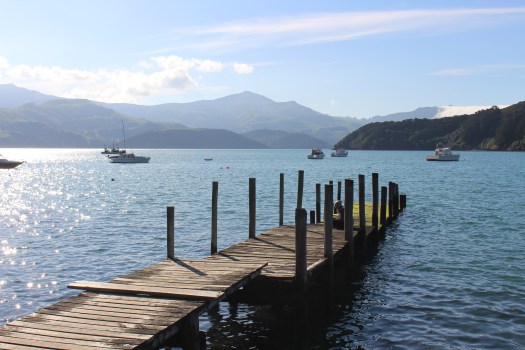
The road to Akaroa is a bit twisty, and yet for your effort you are rewarded with views, great restaurants, penguins, art, and more.

img_1003

Created by volcanic explosion and settled by French pioneers, Akaroa is a small village constrained by steep hills and water.

img_1023

We stayed at the Akaroa Criterion Hotel–great location and management. It is an easy walk along the waterfront to restaurants and shops. It is also next door to Sweet As Cafe.

img_1092

Entertainment, war memorials, and a great store for buying merino wool sweaters and other possum items at Woolworx.

This beautiful spot is in my top three places in New Zealand. Go already!

Hawkes Bay Museum Chronicles ’31 Quake and More

img_1271

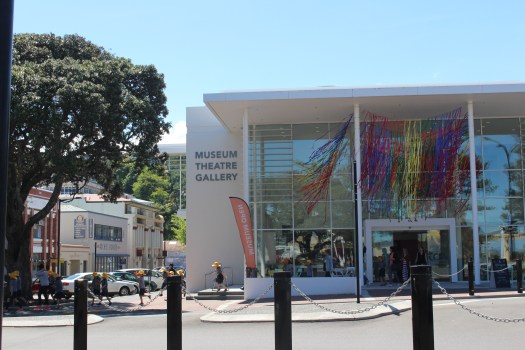
For just $10NZ you can spend a couple of hours happily exploring the exhibits of Maori artifacts, and rotating exhibits of cultural history. My favorite gallery tells the story of the Napier earthquake in 1931 and shows a film on a continuous loop: Survivors’ Stories. It is 35 fascinating minutes.

napier-quake

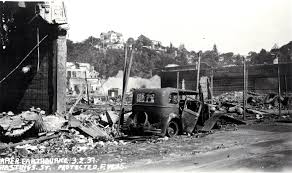
“In 1931, New Zealand’s deadliest earthquake devastated the cities of Napier and Hastings. At least 256 people died in the magnitude 7.8 earthquake – 161 in Napier, 93 in Hastings, and 2 in Wairoa. Many thousands more required medical treatment.” (Te Ara Encyclopedia of New Zealand)

There are many testimonies in the documentary that moved me, but my throat closed a little when someone remembered almost casually how most of the nurses were killed in the initial quake and so everyone had to help as they could do cope with the injured. Oh my.

img_1164If you look at Napier today you can envision how Christchurch can recover; however, not without suffering, not without suffering and hard work.

Postscript:  I watched the video on Sunday with my mom. Her mom was 6 years old and living in Santa Rosa, CA when the San Francisco earthquake struck. She remembers the ground rolling up to meet her as she ran out the door. We thought about the latest NZ quake. We live on the “Ring of Fire” too, so we cannot become complacent. Check your emergency supplies and make sure you are ready with water, flashlights, candles, matches, and other supplies. Click through to this article in SFGate for tips on creating your own earthquake preparedness kit.


Earthquake Recovery: Christchurch

img_1152What people refer to as the  Christchurch earthquake was actually an aftershock of the first quake in September. The destructiveness of the February 2011 aftershock displaced the earlier incident as “the quake” and deservedly so.

Christchurch earthquake 6.3 magnitude on the Richter Scale. (Why Can’t Kiwi’s Fly?, p. 56):

A more accurate measure of how strong an earthquake feels or how much damage it causes is the Modified Mercalli Scale. It gauges the effects of an earthquake on the Earth’s surface, humans, buildings, and trees. It has a scale of I –XII (1-12); on this scale the Christchurch earthquake is rated IX (Violent: general panic, damage considerable in specially designed structures, well-designed frame structures partially collapse. Buildings shifted off foundations.) Some argue the Christchurch earthquake should have been rated as high as X (Intense: some well-built wooden structures destroyed; most masonry and frame structures destroyed with foundation. Rails bent. Large landslides.)

Another measure of the strength of an earthquake is peak ground acceleration or PGA. This does not calculate the total energy (magnitude or size) of an earthquake, but rather how hard the earth shakes. On that scale the Christchurch earthquake recorded one of the highest PGAs ever: at Heathcote Primary School it was an incredible 2.2 g, or 2.2 times the acceleration of gravity. And to compound the destruction, the greater force was upwards, with people lifted off their feet. Only the recent Japanese earthquake in Tohuku, on 11 March 2011, recorded a higher PGA—2.7g.

As geologist Hamish Campbell said: “No wonder so many stone churches, including Christchurch Cathedral, were destroyed. Such structures were simply not designed to be thrown up into the air and left to go into free fall, even though the fall is all over in a matter of milliseconds to seconds.

Wow.

I first visited Christchurch in October 2010. I experienced a small roller during my stay, but I’m from California so I wasn’t unnerved. I’ve never experienced what Christchurchians did for a period of several years: a seemingly never ending series of aftershocks of varying strengths. I feel like I followed it with the Ole JackMeter. My friend David introduced me via Facebook to Ole and Karen and I visited them and got the deluxe tour of Christchurch and Banks Peninsula in October 2010. They were away from Christchurch on the fateful day in February, but they endured many more sleepless nights. It was not uncommon to be woken up by the sound of a train–held in suspense as to the size of the coming trembler. Ole posted on Facebook when there was another significant quake by saying something like it was another “Jack night” meaning he was going to need Jack Daniel’s whiskey to get to sleep. Whenever I read this from my home in California I’d say a little prayer and think of the beautiful city in Canterbury.

Ole and Karen gave me another tour in 2013. Streets and sewer lines were dug up for repairs almost everywhere we drove. Places I had admired in 2010 were in ruins or closed. Upheaval was ongoing including occasional aftershocks. There were also signs of vitality. The Restore Mall had recently opened with shops in shipping containers.

UK Sarah made time on our road trip to meet Ole for breakfast (Karen was on a business trip) and he gave us another deluxe tour. The roads are in much better shape. There are more and more signs of life returning to normal. The Children’s Bookstore I love is closing/for sale; however, it is hard to say if it is earthquake or book industry related. Now the Sumner suburbs are completely cleared and going back to nature. The fallen rock along the Redcliffs is almost completely removed and many people have already rebuilt to a new standard.

I predict that Christchurch will go from tragedy to triumph. It takes time. And they’ve only just stopped shaking.

This documentary gives a moving account of the “big one”.

Postscript: Their Monday morning they experienced more earthquakes (7.8 Richter, 5+ aftershock(s)). The epicenter was further north near Kaikoura. I am sad to see the photos of the destruction of this beautiful seaside town. My prayers are with them. We can also donate to the NZ Red Cross.

Swatch: Cycling to Skeinz

20161102_1406110
You can order yarn and penguins in sweaters on-line.

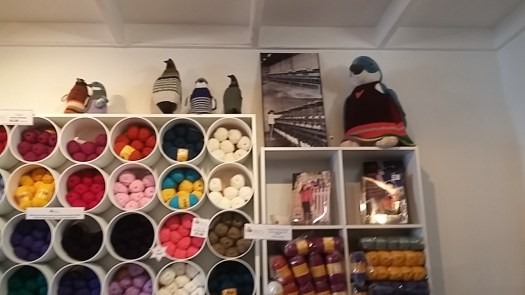
I have been intrigued with the wool shop Skeinz in Napier since 2011. When I was living in St Heliers and the Rena shipwreck happened the shop put a call out for penguin sweaters to help with the recovery. They were completely swamped by the response and the veterinarians only needed a few (their use is actually no longer in vogue). So Skeinz was clever and bought some stuffed little blue penguins and yellow-eyed penguins and sold the sweaters to raise money for penguin recovery and conservation.

The shop is in an industrial part of town because it is co-located with their wool mill and is essentially a factory outlet. Too far to walk and impractical to take a taxi so I rented a 3 speed cruiser and headed to the beach bike path. It was counter-intuitive to go via the Port, but the bike rental guy suggested that there would be less traffic and more scenic.

20161102_150910All good until I got to the transition from the Quays to the light industrial part of Napier called Onekawa. Suddenly I was navigating through roundabouts with logging trucks! I found a new gear fueled by terror! I got lost a couple of times and finally put away my paper map for Ms. Google. My 20 minute bike ride took twice as long, but it was worth it.

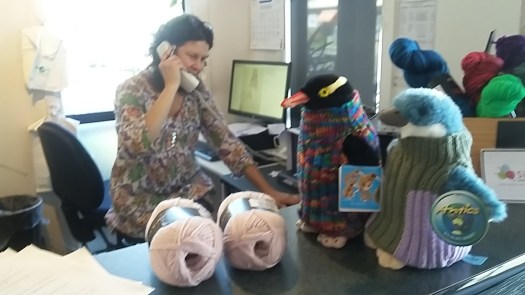
I had packed 2 patterns for a sweater and blanket for a friend’s baby due in December. (I learned the hard way to not depend on being able to find a pattern in a knitting language you can read. And then how much yarn to buy?) Karen helped me find the NZ equivalents of the right weight yarn. I really enjoyed looking at and feeling all the beautiful different wool yarns. Karen figured out how to ring it up so I didn’t have to pay GST and Skeinz ships overseas for free for orders over $100 NZ. I appreciated her assistance especially as there was a steady stream of customers.

20161102_144238
Karen asking the office how she can save me the GST: the key is she has to ship it directly to my home in Sacramento.

I decided to cycle back to the City Centre in the most direct route. It was another blood pumping pedaling experience. When I stepped off my bike I felt very satisfied with my yarn haul and as if I’d wrestled ewe to ground, sheared and spun wool all while being chased by wolf! I went back to my hotel, showered and treated myself to a delicious dinner at Bistronomy.

20161102_153410
$20 NZ for 2 hours with a grace period. Includes helmet and lock.

Penguin Parade at Aquarium

img_1245

The National Aquarium of New Zealand is not very large and only takes about an hour to see the displays, yet it includes a charming Penguin Cove where over a dozen injured little blue penguins live out their days in ease and repose. I watched Dora, the hand-raised penguin who really likes people and swims and chatters at the front of the pool, while another penguin sunned herself on the deck, and a third penguin swam for the joy of swimming. You can view through a window underwater and from above.

When the keepers came out at 1:30 to feed the penguins, almost all of the penguins came out to grab a fish or two. The penguins feed three times a day in view of the public (9:30 a.m., 1:30 p.m. and 3:30 p.m. daily). One keeper shares information about the penguins while the other feeds them by hand. They warn about the threats to penguins like the pollution and fishing line that caught Gonzo and removed his fin and lower beak. The rescued penguins live longer at the aquarium than they would in the wild; one elderly penguin is 21 years compared to 12 years average in the wild. The keeper said she’ll be served her lunch “at home” likes Meals on Wheels.

img_1169

The towns of Napier and Hastings were almost completely destroyed by an earthquake in 1931. Napier was rebuilt in the Art Deco style and continues to celebrate this architectural heritage in festivals and tours. Many cruise ships stop here for a day and one convenient penguin outing is to the Marine Parade and National Aquarium of New Zealand. For over a kilometer along the shoreline there are gardens and walkways that lead from the Hawkes Bay Museum to the Aquarium.

Entry to the National Aquarium is $20NZ for one adult. A family of four can visit for $54NZ. There is special pricing for students and seniors. The aquarium is open from 9 a.m. to 5:00 p.m. The café and gift shop are currently closed for remodeling.

It is a 20-minute walk from the tourist information centre to the aquarium. The paths are flat and easy to navigate if you are in a wheelchair or pushing a stroller. Just across the street from the I-Centre is a bike rental place. For $20NZ you can rent a cruiser with a helmet and lock for 2 hours. Most of Napier is completely flat so you can pedal to the aquarium, see the penguins and continue exploring.

Evening Penguin Safari on Banks Peninsula

One of my earliest penguin experiences was with the Pohatu Penguin Plunge in Akaroa. Several years ago I got up at the crack of dawn in Christchurch and drove out to Akaroa to go seakayaking and observe the penguins in Flea Bay on the Banks Peninsula. It was a wonderful experience, except for getting very, very seasick (but I’m easily prone).

I recently returned to the Banks Peninsula and was able to convince UK Sarah to go with me on the evening penguin safari at the Pohatu Marine Reserve. We reported to the Pohatu Penguin Plunge office in Akaroa and met the 3 other participants and our guide Ben. We climbed aboard the van and began the drive up the side of the old volcanic crater and down the other side to Flea Bay. We stopped along the way for some great views. Ben explained with his French accent the history of Akaroa from volcanic formation, to French settlers landing 4 days after Waitangi Treaty was signed, to the current efforts to conserve the penguin habitat at Flea Bay.

We stopped at the farmhouse to collect binoculars and to put on some camouflage raingear. We also fed bummer lambs a bottle and gave some pellets to the ewes. There is a bathroom here (and the last stop for the next several hours).

We headed the short distance toward Flea Bay—so named because early explorers noted that the penguins here were covered in fleas. Ben took his notebook along to make observations along the way. He reminded us the importance of watching the penguins from hides and not touching them or using flash photography.

It is tricky to time the penguin viewing—the start and finish of tours changes as spring turns to summer—because the penguins have adapted to the introduction of mammal predators by postponing their return to land until nightfall. When we began our walk only a few little blue penguins had returned, and as it got darker, we could see more and more penguins but less and less of them. And the ground is rough (you are walking along a hillside on a sheep and penguin trek not a proper path).

Almost right away we came to an artificial penguin nest provided by the Pohatu Penguin Plunge. If left to their own devices, the penguins would dig out nest in the dirt, but this requires a lot of energy and the colony is struggling to maintain its numbers. Providing the artificial boxes is a common practice approved by the Department of Conservation.

It is easy to tell the occupied boxes by the tell-tale poop outside the door. Each nest is numbered and the lids on these boxes are removable so Ben and others can check on them and track the number of chicks and help to educate us, the interested public. Ben showed us two different nests—one with a male and some chicks and one with a female and some chicks. The chicks were still small and difficult to see. Ben cannot touch the penguins so unless they shift it is difficult to know for certain. He replaced the lids and then added a rock to keep curious sheep out of the nests.

The little blue penguins in this colony are growing in numbers but only gradually. They experienced a 5% dip after the biggest Christchurch earthquake due probably due to stress. Their survival is threatened mainly by overfishing of their food supply and by stoats and other alien mammals harassing chicks and eggs. In the van, Ben explained the Department of Conservation approved poison program and then on our walk showed us a stoat trap. He recently started baiting the trap with mouse juice (pee from pet mice) and is finding more stoats than before. The most vulnerable period for the penguins is during the month or so when they molt and gain a new coat of feathers.

We walked to a set of hides where we could see the little blue penguins without disturbing them. I asked Ben how the chicks finally move out after weeks of being fed by their parents. He explained that the parents finally just stop going back to the nest and the young adults spend several days getting hungrier and hungrier until finally they clamber to the sea and begin fishing for themselves.

img_1084
The Yellow-eyed penguin appeared much bigger to my naked eye than this photo suggests.

We walked to the furthest hide and received our reward: a lone yellow-eyed penguin. He was very handsome preening himself before going home. We watched him for some time. And while we watched we also saw a New Zealand fur seal go into the water from the nearby rocks. The seal swam just off shore and the returning little blue penguins avoided him as they returned from feeding all day.

In this area the white flippered penguins and the little blue penguins coexist and breed with one another. They are not considered separate subspecies. Only along these shores on the Banks Peninsula and Motunau Island will you find the white flippered penguin. I was pleased that with the help of binoculars I could soon tell the difference with the penguins we watched come ashore.

We returned slowly to the farmhouse and returned our gear. It was a lovely experience and the five of us from Scotland, Malaysia, England, USA and France were united in our admiration for the penguins.

The evening penguin safari costs $75NZ per adult and lasts 3 hours. Transportation is provided from Akaroa. No food or drink is provided by the tour company. Reservations are recommended. Uneven terrain may be a challenge for some, ask about accommodation if this is a concern. The Department of Conservation provides guidance for conserving the marine reserve but no funding. The Pohatu Penguin Plunge activities help to pay for the conservation of the habitat in Flea Bay. Best time for viewing is September through February.