I saw my first Yellow-eyed penguin from the hide at Bushy Point, but I was at least a hundred meters above the beach and even with binoculars it was hard to appreciate their unique size and markings. Several times I tried going on a Penguin Place tour and couldn’t fit it in with the Little Blue Penguin experience at the Royal Albatross Centre. I was determined to make it work this time!
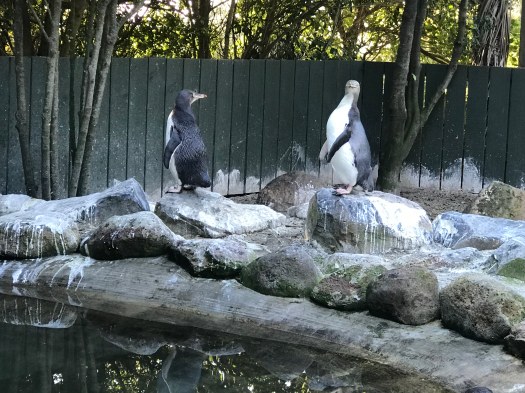
Two Yellow-eyed penguins/hoiho recovering from injury at Penguin Place. Hoiho do not do well in captivity and these two males will be released when ready.
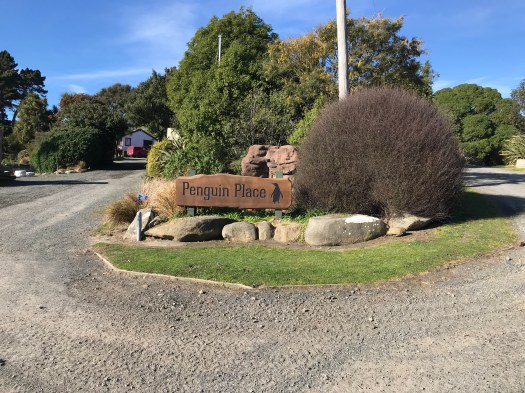
Located on a private sheep farm on the Dunedin peninsula, Penguin Place is dedicated to the conservation and welfare of Yellow-eyed penguins/hoiho. Their efforts to restablish habitat and educate the public also benefits Little Blue penguins. I went in the winter months (April-September) so they only offer one tour a day at 3:45 p.m. In the summer months (October-March) there are 90 minute tours running from 10:15 a.m. to 6:16 p.m.
One advantage of going in the winter is the tour group is more likely to be small. There were just a half dozen of us as we bumped in the bus, through the sheep ranch, and toward the trails that lead to the network of hides.
We had plenty of time to ask our questions as we waited in the hide and looked out at the beach waiting for a Yellow-eyed penguin to return. A large sea lion was hanging out on the beach probably sending “stay away” vibes to penguins. We were not disappointed though. There were two Yellow-eyed penguins who stayed on land all day. One was just a few feet from the hide and another was some distance below the hide but away from the beach and visible to us. We also saw several single and pairs of Little Blue Penguins in their wooden hutches along the trail.
Female hoiho stayed home to prepare her nest.
All of the money from the penguin tourism goes back into rehabilitating penguins in the hospital and conserving the breeding grounds. In spite of the extensive efforts by people and the NZ Department of Conservation, the numbers are shrinking. When I first took an interest in hoiho there were 400-600 breeding pairs on the NZ mainland, and now there are just 266 breeding pairs. There is also a sex imbalance with three males for every female. It is hard to state with certainty what is causing the decline but it is likely warming oceans and changing food supply. Participating in this guided tour is a small way to do your part for the species. And we need to all make changes to address the climate crisis.
One of my earliest penguin experiences was with the Pohatu Penguin Plunge in Akaroa. Several years ago I got up at the crack of dawn in Christchurch and drove out to Akaroa to go seakayaking and observe the penguins in Flea Bay on the Banks Peninsula. It was a wonderful experience, except for getting very, very seasick (but I’m easily prone).
I recently returned to the Banks Peninsula and was able to convince UK Sarah to go with me on the evening penguin safari at the Pohatu Marine Reserve. We reported to the Pohatu Penguin Plunge office in Akaroa and met the 3 other participants and our guide Ben. We climbed aboard the van and began the drive up the side of the old volcanic crater and down the other side to Flea Bay. We stopped along the way for some great views. Ben explained with his French accent the history of Akaroa from volcanic formation, to French settlers landing 4 days after Waitangi Treaty was signed, to the current efforts to conserve the penguin habitat at Flea Bay.
We stopped at the farmhouse to collect binoculars and to put on some camouflage raingear. We also fed bummer lambs a bottle and gave some pellets to the ewes. There is a bathroom here (and the last stop for the next several hours).
We headed the short distance toward Flea Bay—so named because early explorers noted that the penguins here were covered in fleas. Ben took his notebook along to make observations along the way. He reminded us the importance of watching the penguins from hides and not touching them or using flash photography.
It is tricky to time the penguin viewing—the start and finish of tours changes as spring turns to summer—because the penguins have adapted to the introduction of mammal predators by postponing their return to land until nightfall. When we began our walk only a few little blue penguins had returned, and as it got darker, we could see more and more penguins but less and less of them. And the ground is rough (you are walking along a hillside on a sheep and penguin trek not a proper path).
Almost right away we came to an artificial penguin nest provided by the Pohatu Penguin Plunge. If left to their own devices, the penguins would dig out nest in the dirt, but this requires a lot of energy and the colony is struggling to maintain its numbers. Providing the artificial boxes is a common practice approved by the Department of Conservation.
It is easy to tell the occupied boxes by the tell-tale poop outside the door. Each nest is numbered and the lids on these boxes are removable so Ben and others can check on them and track the number of chicks and help to educate us, the interested public. Ben showed us two different nests—one with a male and some chicks and one with a female and some chicks. The chicks were still small and difficult to see. Ben cannot touch the penguins so unless they shift it is difficult to know for certain. He replaced the lids and then added a rock to keep curious sheep out of the nests.
The little blue penguins in this colony are growing in numbers but only gradually. They experienced a 5% dip after the biggest Christchurch earthquake due probably due to stress. Their survival is threatened mainly by overfishing of their food supply and by stoats and other alien mammals harassing chicks and eggs. In the van, Ben explained the Department of Conservation approved poison program and then on our walk showed us a stoat trap. He recently started baiting the trap with mouse juice (pee from pet mice) and is finding more stoats than before. The most vulnerable period for the penguins is during the month or so when they molt and gain a new coat of feathers.
We walked to a set of hides where we could see the little blue penguins without disturbing them. I asked Ben how the chicks finally move out after weeks of being fed by their parents. He explained that the parents finally just stop going back to the nest and the young adults spend several days getting hungrier and hungrier until finally they clamber to the sea and begin fishing for themselves.
The Yellow-eyed penguin appeared much bigger to my naked eye than this photo suggests.
We walked to the furthest hide and received our reward: a lone yellow-eyed penguin. He was very handsome preening himself before going home. We watched him for some time. And while we watched we also saw a New Zealand fur seal go into the water from the nearby rocks. The seal swam just off shore and the returning little blue penguins avoided him as they returned from feeding all day.
In this area the white flippered penguins and the little blue penguins coexist and breed with one another. They are not considered separate subspecies. Only along these shores on the Banks Peninsula and Motunau Island will you find the white flippered penguin. I was pleased that with the help of binoculars I could soon tell the difference with the penguins we watched come ashore.
We returned slowly to the farmhouse and returned our gear. It was a lovely experience and the five of us from Scotland, Malaysia, England, USA and France were united in our admiration for the penguins.
The evening penguin safari costs $75NZ per adult and lasts 3 hours. Transportation is provided from Akaroa. No food or drink is provided by the tour company. Reservations are recommended. Uneven terrain may be a challenge for some, ask about accommodation if this is a concern. The Department of Conservation provides guidance for conserving the marine reserve but no funding. The Pohatu Penguin Plunge activities help to pay for the conservation of the habitat in Flea Bay. Best time for viewing is September through February.



 americanjulie.com