
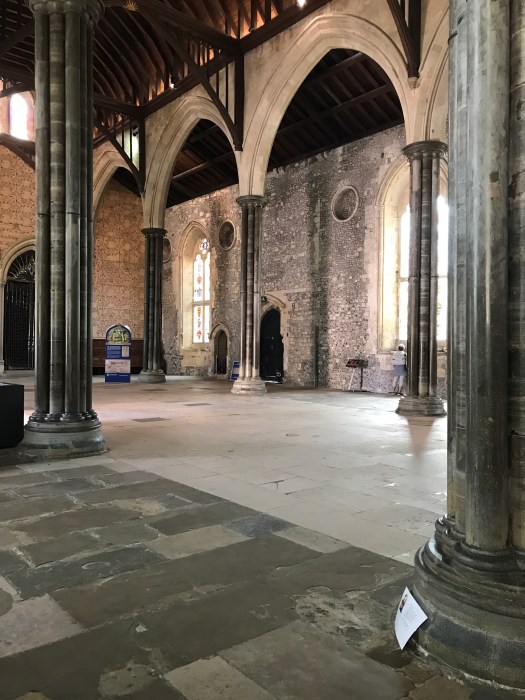
The Great Hall, built in 1235 by Henry III, is the last remaining building from the great Winchester Castle. After his coronation at Westminster Abbey on Christmas Day 1066, William the Conqueror began building the castle. Henry III had a love of architecture and commissioned Elias of Dereham to oversee building of the Hall. Dereham also oversaw the construction of Salisbury Cathedral and is the only commoner to be honored in the stained glass windows.
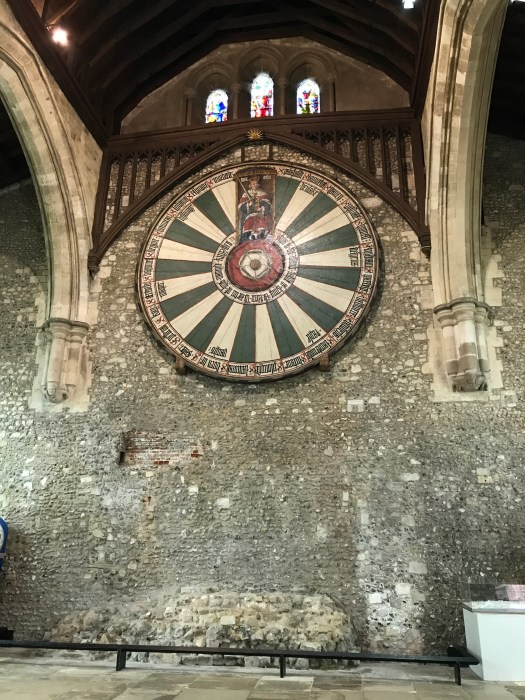
The Great Hall has been used for many functions: court trials, weddings, and a “round table.” Tournament is Edward I time were called “round tables” where courtiers dressed up from Arthurian legend and participated in jousting and feasting.

“Edward I believed strongly in the myth of King Arthur. He attended many round table feasts. Edward had the table build within the Great Hall, which may have been for a round table tournament in 1290 to celebrate the arranged marriages of his children.” (The Great Hall Where History and Legend Meet, Hampshire County Council)
Henry VIII first visited Winchester as King in 1516, whereupon he ordered the repair of the Great Hall at Winchester and the Round Table. This is when it was first painted in the design you see on display today.
Winchester Castle was largely destroyed by that spoilsport Oliver Cromwell after 1645. Only the Great Hall remains and it is now the responsibility of the County of Hampshire.
The Great Hall makes the most of its sketchy connection to King Arthur. I’ve seen Excalibur and read a bit about it, but I admit my knowledge has some big blanks, so I was excited to read Rosie Schaap’s New York Times travel article, “King Arthur Slept Here (Maybe).” She asserts that the places to visit if you are interested in an Arthurian pilgrimage are Glastonbury, Tintagel, Totnes and Padstow. Her article then goes on to describe the kind of new age and coven-catering shops you can find almost anywhere in California. None of her experiences relate to King Arthur. Perhaps Avalon is best left to the imagination.


 The women who offered assistance in the shop were friendly and interested in what I was working on. I showed them the pineapple baby hat I was knitting for my grandson Calvin.
 The author of five sublime novels, Jane Austen moved to Winchester seeking medical treatment at the end of her life. Her beloved sister Cassandra joined her at No. 8 College Street. Although Winchester was a renowned medical center, her doctor Giles King Lyford did not hold out hope. Indeed, Jane crossed over on July 18, 1817, 200 years ago today.
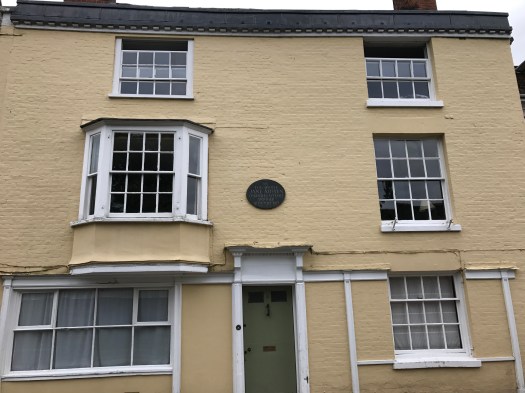 Her temporary home makes a good first stop. Further down the road on College Street is the elite boys prep school Winchester College. Across the street from No 8 is a small park with several Jane tributes. Stop in the awesome independent bookstore
  My last stop on my Jane Austen adventure was to the special exhibits at the Discovery Centre and library. If you are not already familiar with Jane’s life story, then this is the place to start. I also picked up a helpful brochure at the City Museum “Jane Austen’s Winchester” that provided a helpful overview of her time in Winchester 24 May – 18 July 1817.
 I have a specific time in June when I will be in Hampshire county and Winchester, so I will be able to see three exhibits at the Winchester Cathedral where the novelist is buried:
 americanjulie.com