National Trust Membership Mystery

My son and I visited the National Trust property Castle Ward in Northern Ireland. It is the property used to film Game of Thrones “Winterfell.”  When we entered the property the person in the guard house asked if we are members of the National Trust. We are not because we live in the USA and do not come to the United Kingdom (includes NI) very often. She gave us a brochure for the Royal Oak Foundation, urging us to consider membership and implying that there are places we could use it in the USA, yet neither of us had ever heard of it. “Royal” in the title is suspicious too!

IMG_6116

Essentially, it is a National Trust membership for Americans. It gives the same membership privileges when you are in the UK, but there are no properties in the USA that the membership will gain entrance or that has reciprocal privileges.  It still might be a good action to take if you are going to visit a lot of National Trust sites. In Northern Ireland we came across two: Giants Causeway and Castle Ward, so it only makes sense if you are a historical preservation enthusiast.

Post script: We stopped at the Tea Room at Castle Ward and shared a turkey sandwich with stuffing and cranberry. It was Friday, the day after Thanksgiving so it was lovely to partake in “leftovers.”

Mooching Round South End Boston

IMG_6002My son has an apartment with a beautiful view from the 15th floor in a building that is in the neighborhood called “Ink Blot” that is part of the South End of Boston. It is a great place to stay because it is easy to catch the T and visit other parts of Boston and it a great neighborhood to mooch around.

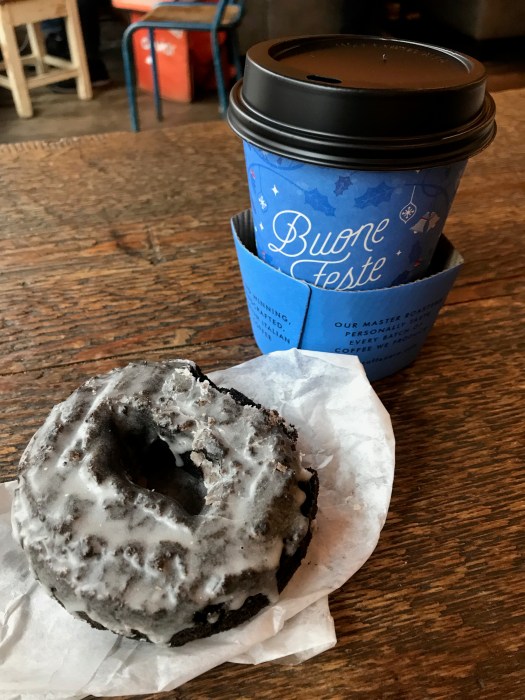
This morning I took my time getting up and then I walked through the rain to Blackbird donut shop. These donuts are delicious. The chocolate cake donut was like a super good slice of chocolate cake. Alas, like many places in Boston, there is no where to sit. This is a city with sucky weather–rain, snow, cold wind, muggy hot–and yet many restaurants serve you food and offer no real space to consume it.

I needed to find a post office, so I set off toward the closest one and stopped at a Cafe Nero on my way and ate my donut with a cup of good, hot coffee. (They have decaf coffee on tap! Bonus points.) Then I began walking back toward SoWa art studios. My path took me past some public housing projects and the Holy Family Cathedral undergoing restoration. This is appears to be paid by the City of Boston!? Interesting. My church St. John’s Lutheran is having to pay more than $600,000 for a historically accurate roof and the City of Sacramento is giving us the opportunity to apply for a grant up to $25,000. Not saying one is right or wrong, just different.

I was ready for something hot to drink and a walking break from the cold rain. I remembered that the nonprofit More Than Words should have completed their remodel and reopened. Voila! The gorgeous retail space is open. It feels good to shop when you know that young people are also given the opportunity to learn life/work skills. Alas there is a reading room but no coffee. I made a contribution (haha) and then pressed on to Cuppa Coffee on Traveler Street. I was just about back to my son’s apartment building.

What a lovely morning, in spite of the wet cold weather.

Fall Into Harvard Square

Oh how lovely to be out of the smoke choking the Sacramento Valley. Oh to be enjoying some rain.

I am visiting my son in Boston and it has been over 15 years since I’ve visited Cambridge, so while he worked at his office, Mid morning I rode the Red Line to Harvard Square. It was such a pleasure to walk 5 minutes from his South Boston apartment to the T-station. Then it was a 7 stops and about 30 minutes and a fraction of the cost of a Lyft ride.

I did a quick walk to stretch my legs to the old cemetery and Cambridge Commons. The brisk autumn air and orange and red leaves clinging to the tree branches were enjoyable in the light rain. As I walked back towards the Harvard yard a family of 5 asked where they might find something to eat. From the Commons they couldn’t see all of the restaurants or the Square a short walk away. I pointed them in the right direction and then we laughed when we realized we are all visiting from California.

I walked through the Harvard Yard and looked at the heart of the campus. It was chock full of tour groups. I was busy remembering my visit with my daughter Sarah when she was in middle school, and then the Gilmore Girls episode where they are visiting Harvard University (although I’m pretty sure it was filmed at Pomona College). I didn’t have much information so I mostly just gawked. I would have benefited from a more organized tour. I don’t want to take the spot of a potential student with one of the free campus tours offered by the University; however, there is also a self-guided tour you can utilize to learn more about the campus.

I made a beeline to Harvard Book Store, a robust independent bookstore. I also checked out the student center on Harvard Square while looking for a fountain soda. Students at Harvard only have healthy options. I ended up getting a slice of pizza at OTTO and then finding a fountain soda and a place to sit and rest for a minute.

One of my highlights, as a devoted gramma, was the Curious George children’s toy store. Upstairs they still have the sign for “Dewey, Cheatem and Howe” law firm made famous by NPR’s Car Talk guys.

It is only a few days before Thanksgiving so I wasn’t sure how many students to expect. Cambridge was buzzing with all sorts of people–groups of tourists, prospective students, grad students, groups of academics, and more. I weaved my way back across the yard to get a closer look at the Memorial Hall. The lobby was open but the theater and the freshman dining hall were closed. This is an awe-inspiring cathedral to higher learning with high timber ceilings and stained glass windows. The dining hall looked like the Hogwarts dining hall and I later learned that the filmmakers did use it as a model.

I started to make my way back to the train station. The train was much more crowded on the way to the Back Bay. I had to switch to the Green Line and was confused as to what stop I needed. When you are underground and there are no bars, you cannot ask Google. So I did it the old fashioned way: I asked for help from a kind young woman. She showed me how I could choose any of three lines to get to Hynes Center stop. I followed her ACROSS THE TRACKS. It felt so awkward but it was safe.

Boston is a charming city and a manageable size. I look forward to more adventures tomorrow.


Retracing the March in Selma

Selma is essential for any civil rights crawl.

Everything in Alabama is close-by. This is the beauty of planning a civil rights crawl. You can cram your day chock full of learning and eating with barely any time wasted in the car. It also means that you may try to do too much in one day. We found ourselves in this predicament as we drove from Montgomery to Tuskegee then back towards Selma then on to Marion with stops along the way. We did not have time to carefully follow the Selma-to-Montgomery National Historical Trail. We also arrived in Selma after the National Voting Rights Museum closed.

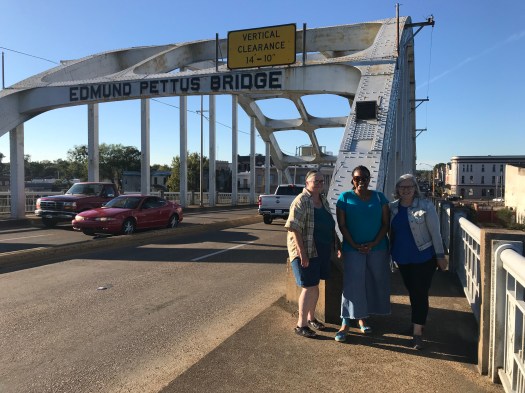
IMG_5505We were able to walk across the Edmund Pettus Bridge and imagine what it must have been like to reach the peak of the bridge, high above the Alabama River, and face a sea of mounted police and police cars with blue lights flashing. I was energized by a group of high school students who started their walk with us but quickly outstripped us. We’d see them again at Brown Chapel. We also spoke with some fellow travelers—a group of friends from Texas and New York–who met up in Alabama. They recommended we also see the Old Live Oak Cemetery.

We took their advice and drove to the cemetery. It is spooky with ancient Live Oak trees dripping with Spanish moss. We all thought of Savannah, Georgia and the cemetery in Midnight in the Garden of Good and Evil movie. The Selma cemetery is well cared for and interesting. Thanks to our friends we knew to walk deeper through the plots to an area dedicated to the remembering the Confederacy. There were confederate flags on many of the graves, memorials to Jefferson Davis and General Nathan Bedford Forrest. The area is maintained by the United Daughters of the Confederacy, Selma Chapter 53. It is also unsettling and helped us understand why Selma as a city has not been able to move on since the 1960s. It looks like it has been in a long state of decay since the Selma-to-Montgomery March. This is a community that has not made peace with its past.

IMG_5518The contrast of the large lawns and stately homes near the cemetery with the George Washington Carver apartment complex across the Brown Chapel AME Church is stark. We pulled up to the church as the high school students were leaving and Chantay spotted the church pastor. She spoke to him and enjoyed a tour of the sanctuary while Phyllis and I admired the Martin Luther King, Jr. monument. The pastor was very generous with his time and gave Chantay commemorative key chains to share with us.
We drove about 40 minutes through beautiful countryside to Marion, Alabama. The March really starts here. Jimmie Lee Jackson was shot by a state trooper during a peaceful protest for voter rights on February 18, 1965. This prompted a peaceful march from Selma to Montgomery on March 7, 1965. Reverend Hosea Williams and John Lewis stepped from the pulpit of Brown Chapel Church and led 600 marchers six blocks to the Edmund Pettus Bridge where the Sheriff and mounted deputies met them with nightsticks and tear gas. Known as “Bloody Sunday” it sparked the expanded civil rights movement in Alabama. Rev. Martin Luther King Jr. came from Atlanta and helped to plan the Minister’s March and then the Selma-to-Montgomery March.

Insight into a Young Dr. King

IMG_5413 (1)

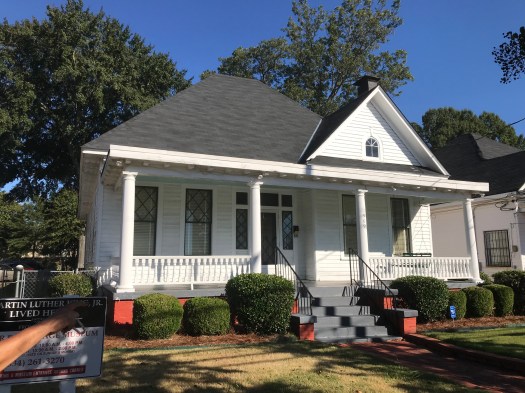
We rushed to arrive at the Dexter Parsonage Museum where Dr. Martin and Coretta Scott King lived while he served as pastor of the church. This is where he was elected president of the Montgomery Improvement Association that organized the boycott and the Southern Christian Leadership Conference. The tours start on the hour and we knew the last tour would be at 3:00 p.m.

I was not sure what to expect when we entered the first house and into the gift shop where tickets are sold. Our lovely elderly tour guide, Mrs. Margeurite Foley, escorted us out to the front sidewalk and began sharing with us what it was like to live in the neighborhood in the 1950s. We saw where a bomb tore a hole in the porch (and fortunately no one was injured). Then we entered the living room and could easily imagine the family life and entertaining they might have done from their home. Some of the furniture is the same as Dr. King and his young family used.

IMG_5414 (1)

We realized when we got to the dining room that Mrs. Foley was a contemporary of the King family and knew him as her pastor. The quality of our questions and discussion changed and it was thrilling. I’ve visited famous people’s homes before—Frank Lloyd Wright for example—and none has moved me in the way this glimpse into the personal life of Martin Luther King Jr. did. Chantay was especially touched to see the photo of Ghandi on his desk in his study.

We drove around the Dexter Avenue King Memorial Baptist Church on our way to the Parsonage. Martin Luther King, Jr. began his career as a minister and an activist at this church. The meeting to launch the Montgomery Bus Boycott was held in the basement of the church on December 2, 1955.

Dexter Avenue King Memorial Baptist Church  454 Dexter Avenue (a block west of the State Capitol), Montgomery, AL 36104  www.dexterkingmemorial.org

Dexter Parsonage Museum  303 S. Jackson Street (south of Monroe Street), Montgomery, AL 36104

Tour schedule: On the top of the hour Tuesday through Friday: 10:00a.m., 11:00a.m., 1p.m., 2p.m., 3p.m. and Saturday 10a.m., 11a.m., 12p.m., 1p.m.

The website recommends you contact them and make a reservation for your tour and this made sense once we arrived and realized the tours are powered by volunteers.

Railroad Museum Thrills Grandson

IMG_5937
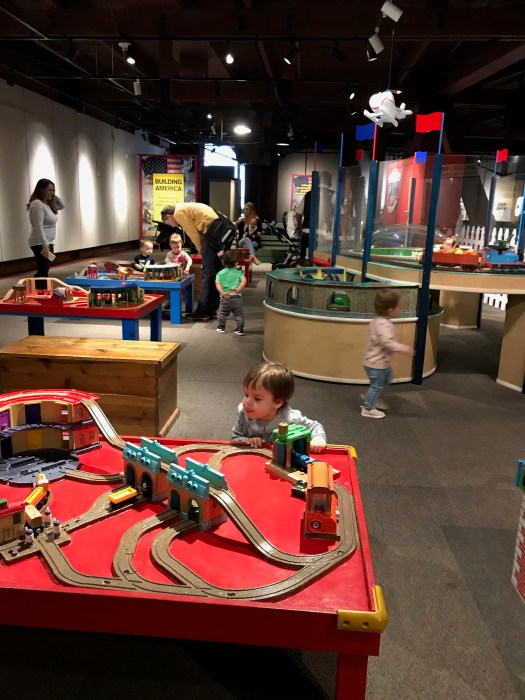
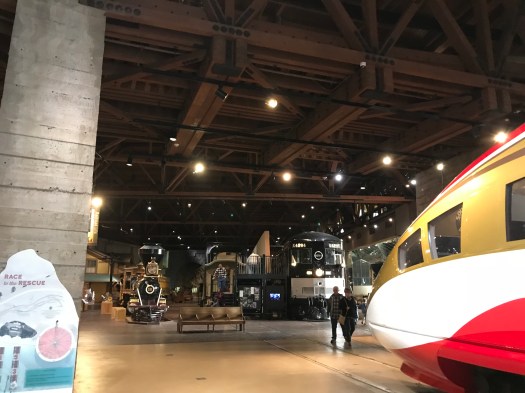
Ground floor of the railroad museum, sometimes called the train museum

I have a beloved toddler grandson and he and I go on adventures most Friday mornings. He likes being outside so we rotate between the Sacramento Zoo, Effie Yeaw Nature Area, and McKinley Park. About 6 months ago we went to the California State Railroad Museum one afternoon about 3:00 p.m. We had to park some distance from the museum and walk past the horse drawn carriages. So we rode the carriage and had them drop us at the museum. Then we became fascinated with the wooden sidewalks, the cobblestones, the full size caboose by the river, then the river, then the turntable for turning engines. By the time we made it back to the museum it was almost closing.

This time we got there as it opened at 10 a.m. Staying outside was not an option as the smoke from the Camp Fire (Paradise, 2018) was just too great to stay outdoors. When we walked through the entrance Cal saw a train engine and his smile was huge. He was so excited he was starfishing with his hands. When the greeter asked if anyone was a member or wanted to become a member I knew I might as well invest right away.

Admission is $12 per adults, $6 per child 6-17, free for children 5 and under. Memberships start at $30 per year, so it is worth considering. The museum is open daily from 10a.m.-5p.m. except Thanksgiving, Christmas, and New Year’s.

56408582734__B2C234D8-29E9-4333-9140-D9267D4BE3E6I used to bring my children here about 25 years ago. My son and daughter were not as excited about trains as my grandson clearly is. At the urging of the greeter we went directly up the stairs to the 3rd floor to where the model trains are displayed. There is also a “toy room” where wee people (ages 2-5) can play with wooden train sets. I was concerned that Cal would never willingly leave. He was over the moon.
IMG_5939
Tom also recommends checking out the holiday “Polar Express” extravaganza.

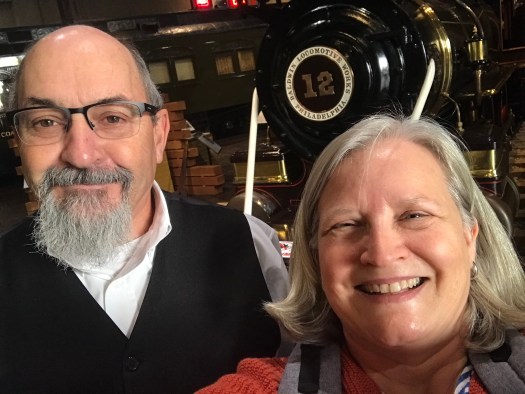
We did eventually make it back to the ground floor to climb aboard all kinds of train engines and train cars. We saw a mail car, a sleeper, and a dining car. When we climbed up to the biggest engine we found our family friend Tom! He volunteers as a docent 2 days a week. He loves trains and he clearly enjoyed telling people about this engine. In fact, I believe the museum has more volunteers than any venue in Sacramento and they definitely make the experience.

We will be returning often.

P.S. The gift shop is also a great place to find things for the train enthusiast. You can shop without paying admission.


Moved Deeply at Civil Rights Memorial

The memorial designed by Maya Lin was closed for refurbishing when we visited in October, 2018. Even without this part of the experience, our visit to the Southern Poverty Law Center‘s Civil Rights Memorial was deeply moving. As you move through the first part you are invited to learn about 40 people who gave their lives for civil rights. Their stories were deeply moving.

IMG_5432

There is a small theater where a film about the civil rights movement plays at regular intervals. Then you move through a hallway with a timeline that records more recent hate crimes and people who have given their lives for our freedom.

Another area features quotes from leaders that prompt contemplation and reflection. This would naturally lead to the memorial itself. I look forward to visiting at a time in the future when this water feature is restored.

Just a short walk away is the Freedom Riders Museum. It is one of the places we did not have time to visit. We regretted this when we were in Birmingham and learned more about the brave Freedom Riders riding Greyhound buses to desegregate bus service in the South.

Remembering Tuskegee Airmen on Veteran’s Day

Tuskegee is famous for many things including the African American airmen who were trained as pilots and served in WWII. Tuskegee is about a 40-minute drive east of Montgomery and worth the effort. Our first stop was the Tuskegee University campus. We were trying to find the Tuskegee Institute National Historic Site and Google Maps was not able to provide directions beyond the University entrance. Twice we slowed to ask a college student for directions and twice she turned out to be a freshman from California and unable to help us. We finally parked by the chapel and started our own Tuskegee education at the monument honoring the Institute’s founder, a fierce statue of Booker T. Washington helping a former slave out of ignorance.

Many of the venues have similar names and it can be confusing. We were able to visit the Carver Museum, a short walk away from the Booker T. Washington monument. The Carver Museum’s exhibits, operated by the National Park Service, are a bit fusty. It is still worth watching the film about Carver’s brilliant science career. George W. Carver sought an education at great sacrifice and ultimately trained as a scientist specializing in developing agricultural crops. He published his research in easily understandable bulletins (a precursor to the USDA bulletins). We enjoy hundreds of foods and products because of his work, including popularizing the sweet potato. I dare you to be less than bowled over by his creativity, productivity and selflessness.

Afterward we drove to the outskirts of town to Moton Field where the Tuskegee Airmen trained. It is a beautiful airfield and still operates for private planes. The National Park Service has a few markers to help orientate you and to tell about the Tuskegee airmen. While we were there a group of US Airforce service people were wrapping up their visit. I was glad that we already knew that their brave and capable service helped to pave the way for desegregation of the armed forces. I was struck by how small the airfield was compared to the decommissioned Airforce bases in Sacramento (McClellan and Mather). Small but mighty.

Life Lesson You Don’t Have to Learn the Hard Way

I used the Alabama Civil Rights Trail brochure as my guide and did not go to the National Park’s website until after we returned home. And even then it wasn’t until I dug deeper that I discovered that we missed the Hangar #1 & Hangar #2 museums at Moton Field. They are currently open Monday- Saturday 9:00 a.m. – 4:30 p.m. CST, except Thanksgiving, Christmas, New Year’s Day and Sundays.


Getting out of the Smoke to Apple Hill

The smoke from the Camp Fire in Butte County is so thick there is no way we could enjoy a morning out of doors with my grandson anywhere in the Sacramento Valley. So we drove east to Placerville and to Apple Hill just beyond.

Apple Hill is an established trail of family farms and orchards. Long ago when I was a child, Apple Hill was only open in the fall and closed once everyone had come to get their Christmas tree. The main locations to stop and buy pie or apples were straightforward. These days Apple Hill is open June-December and the pie and apple stops are jammed with tents of vendors selling everything from wax hand art to signs warning your neighbors about your “crazy dog.”

Our first stop was at the El Dorado Orchard for the train ride. They have had a short train ride around 2 ponds for several decades. The ponds need some rain and the ducks and geese are gone, but the train ride still was a pretty ride past vineyard and orchard. The cost of a ticket has gone up to $3.50 a person but still better than $5 a person for a hay ride at the next stop.

IMG_5892
Traditional apple pie, heated. Yum!

We drove about another 5 minutes to High Hill Ranch co-located with the Fudge Shop Farm. We parked among the apple trees and walked up to the main pie shop. It is built like an old fashioned ski lodge and the view from the deck is really splendid. It was lovely to see some blue sky. The apple pie was delicious. I prefer my apples more tart but the crust was as good as mine.

IMG_5878

It is a quick trip down the hill and back into the smoke. My thoughts and prayers go to the many families impacted by the Camp Fire in Paradise, CA. As of this writing nearly 6,500 families are homeless and the fire is threatening the town of Oroville. Please join me in donating to aid these communities through your preferred charity. Mine is the Evangelical Lutheran Church of America Disaster Relief.

Rosa Parks Still Inspires

IMG_5409
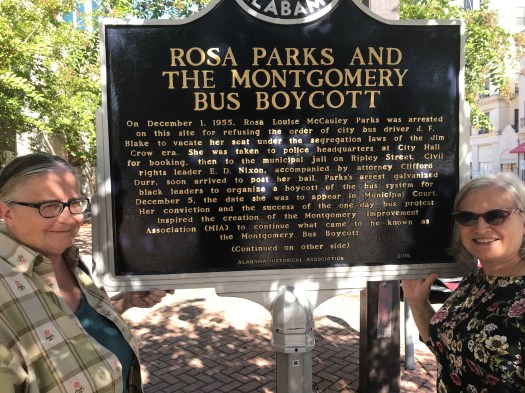
Phyllis and me at the site where Rosa Parks was arrested for refusing to give up her seat on the bus. It is adjacent to Troy University’s Rosa Parks Museum.

The historical marker on the spot where police boarded the city bus to arrest Rosa Parks for not giving up her seat for white passengers is also the site of the Rosa Parks Museum at Troy University. We bought our tickets and strolled the hallways looking at the Gees Bend quilts and other art until the tour started.

IMG_5410Our group was ushered in to the first room where we watched a video giving us more information about Rosa Parks. Many know her story in the most simplistic terms: woman is tired of the segregated city bus policies and one day refuses to give up her seat. The reaction from her community sparks the civil rights movement. This is true is in its essentials and glosses over a lot of important details. The video begins to redress the gaps. Our esteem of this diminutive hero increased.

The second room has an actual old city bus and a nifty multi-media reenactment. It is clever in relating the atmosphere and the details of the event. The doors then open to further exhibits that give more context of Rosa Parks’ brave action. It also tells the story of the year-long bus boycott and other details of Rosa’s life.

IMG_5411

While we were there, the museum curators were organizing a new exhibit that included artwork inspired by Parks and artifacts from her arrest. We would have lingered longer except we wanted to visit the Dexter Street Church Parsonage before it closed.

Rosa Parks Museum

252 Montgomery Street, Montgomery, AL 36104 (334) 241-8615

https://www.troy.edu/rosaparks/

Hours: Monday-Friday 9a.m.-5p.m.; Saturday 9a.m.-3p.m.; Closed Sundays and holidays

Ticket prices: 12 and under $5.50 per person; Over 12 $7.50 per person; various discounts available.