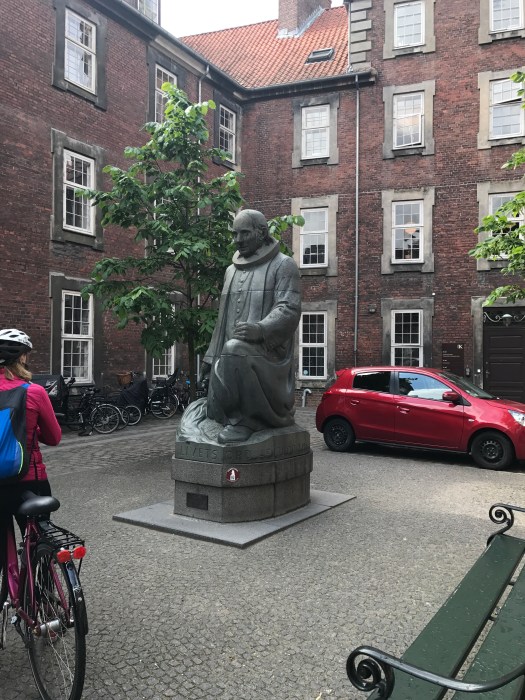
One of the early stops on Bike Mike’s tour of Copenhagen was at the statue of NFS Grundtvig, often called Father Denmark. Mike took the opportunity to share with us a little history and how Denmark developed the socialist democracy and earned their title of world’s happiest people.
Grundtvig wrote histories reintroducing the Norse gods to the Danes. He also studied English society and appreciated the contrasting freedom of thought and pragmatism. He was also a Lutheran pastor who spoke out for separation of church and state. All of this combined to the philosophy Grundtvigianism. He also participated in writing the new constitution and articulated the sense of community that is now a hallmark of the Danish life.
Mike said, “We don’t mind paying high taxes because we get free education, elder care, health care and day care.” He laughed and pointed out that since women ruled Denmark there have been no wars, they work less and earn more, and they enjoy the smallest gap between the poorest and the wealthiest citizens.
Denmark is not perfect, but one of the things I love about travel is learning about other cultures and seeing how things can be.
If you want to read more about Grundtvig you can in Knud JV Jespersen A History of Denmark. (in English)
This year, as in every year, I briefly thought I would watch the Tour de France casually. I would not become obsessed and thus avoid the highs and lows of cycling in July and the gutted feeling when it is over and forgo getting up at 5:30 a.m. PST.
Then I got this email.
I bought the NBC Sports Gold pass for cycling during the Tour of California in May. It did not include the Giro but it will include the Tour de France. I watch on my computer, follow VeloNews and the @letour on Twitter and watch every episode of Orica Scott Backstage Pass on YouTube.
The favorites are Chris Froome (Sky), RIchie Porte (BMC), or Nairo Quintana (Movistar) for the overall General Classification or yellow jersey. The race begins on July 1 with a time trial in Dusseldorf, Germany. Will my favorite Tony Martin win on home turf? Will Germans Marcel Kittel or Andre Greipel turn themselves out to win a stage at home? Will Mark Cavendish be healthy enough to compete? Will best rider in the world Peter Sagan win the green jersey again? We’ll know when Le Tour finishes in Paris on July 23rd.
If you like listening to podcasts. My cycling favorite is The 3 Domestiques. I listen on the Stitcher app to Matt Keenan, Sam Edmunds and Dan Jones discuss pro-cycling with great interviews.
So set your alarm and don’t miss the drama, the athleticism, and the tradition.
I bought this fan kit in England and mailed it home in a box of books. It just arrived!
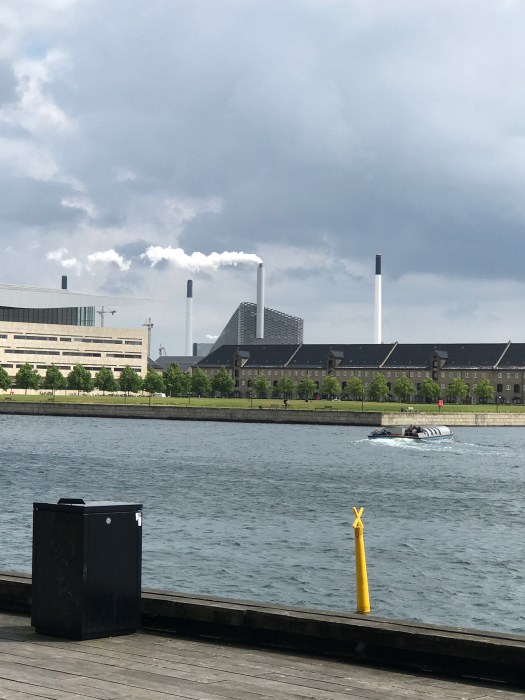
The waste management facility is the building in the middle of the photo behind the smoking stack. The sloping roof is a ski slope and the facility’s technology means the smoke is free of nasty pollution and converts household waste to energy.
I learned about the new waste management facility with the ski slope on the roof from watching the Bjarke Ingels episode of Abstract: the Art of Design on Netflix. He’s a Danish wunderkind architect with a firm BIG. More cool than the rooftop ski run is the technology that takes household waste and makes clean energy. This technology is also used in Sweden. (Why aren’t we doing this in the USA??) You know it’s clean because they just built expensive homes next to it.
P.S. It was exciting to make this connection to an episode of one of my favorite original programs on Netflix:
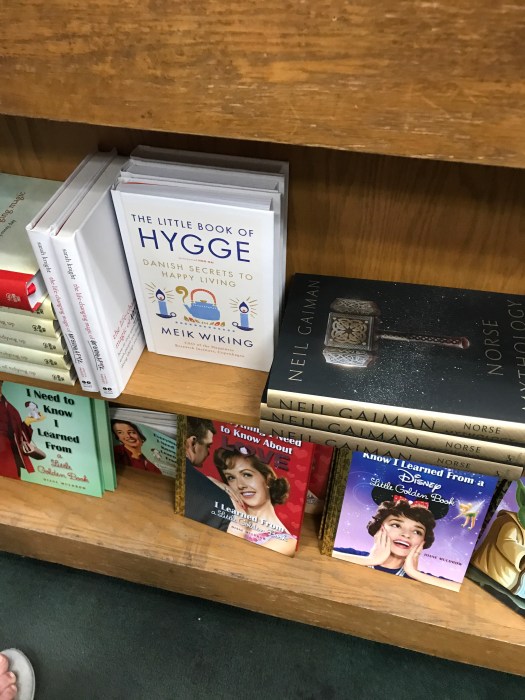
I heard about hygge (hoo-ga) before I went to Denmark. Every year Denmark and Norway compete for “happiest people on Earth” and a big part of that is attributed to this value for hygge. I was looking for a book on Denmark’s history when I discovered Meik Wiking’s The Little Book of Hygge (in English of course). I bought it because I loved the design and thought my daughter would like it.
Wiking is the head of the Happiness Research Institute in Copenhagen where he studies living well. I learned quite a few things about hygge from his book. First, unscented candles are critical to creating hygge, best translated in English as “cozy togetherness” Most Danes use lots of candles, lots of sweets and lots of ham and bacon, washed down with coffee or hot chocolate. The ideal number of people to enjoy this cozy time is 3-4 so it is perfect for introverts. The dress code is comfy/casual and often everyone watches “box sets” (think binge watching on Netflix) or plays board games.
I did find it interesting that the book compares the idea of Danish “hygge” with similar words/ideas in Norway, Netherlands, Finland and even Canada, but ignores Sweden. And yet the one place I experienced hygge was at my University chum Susie’s home in Malmo, Sweden. Whereas my hotel, The Absalon, and restaurants were all about Danish modern design. They were stylish but more formal and un-hygge.
My friend Susie explained the competition between Sweden and Denmark. The Danish are smug about their superiority to Sweden. Swedes don’t seem to spend much time thinking about Denmark. It reminds me of the competition between NorCal and SoCal, with NorCal the Danes with a little bit of a chip and SoCal as Sweden too absorbed with its own business to give the other much thought. Susie and her family explained that they enjoy Friday evening television watching with the family, Saturday family time when children get 10 pieces of candy, and Sunday cozy time with family. It’s a lot of togetherness with family.
Work/life balance is very important to all Scandinavians and remember that when you are headed somewhere in a car. People with children knock off work at 4 and others at 5, so rush hour starts early!
I definitely came home thinking I’d like to incorporate more hygge in my life. And you can too. I was in Avid Reader bookstore in Davis, CA and lo and behold, there was a copy just like mine. So I didn’t have to lug it all over Denmark and England and you don’t have to go to Copenhagen to get the book.
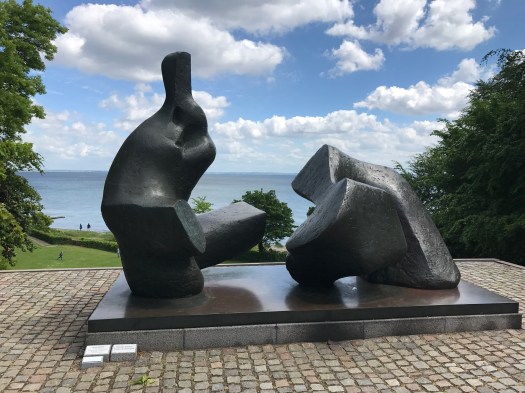
It did seem odd that the name of the most visited art museum in Denmark is called the Louisiana MOMA. It is actually named for the villa that looks like a Louisiana plantation house and it was named after Alexander Brun’s three wives who were all named Louise. It has been transformed over the years into an exquisite sculpture garden and gallery all hugging the shores of Oresund Sound in Humlebaek.
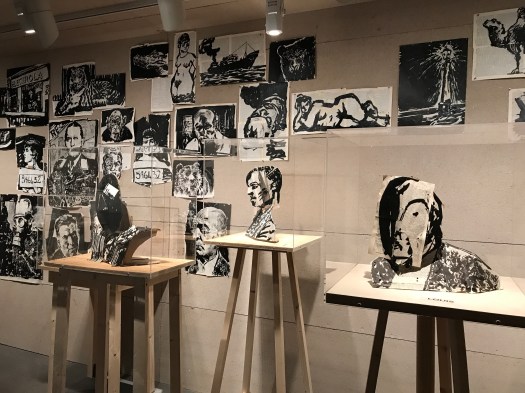
The train takes you to within a 10 minute walk of the Museum. The museum has a permanent collection both indoor and out, plus 2 special exhibits. When I visited I was able to view the retrospective for Danish artist Tal R and a fascinating exhibit of South African artist William Kentridge. I was disappointed because the Marina Abramovic exhibit was due to open the following Saturday, but then I’d have missed Kentridge. (I know, first world problems.)
Four powerful paintings by Danish artist Tal R
I wandered the grounds looking at the sculpture and then stopped at the cafe to eat lunch. I’d been told by a fellow plane passenger that the smorresbrod at the Louisiana Cafe was delicious. I can confirm that the salt-cured ham, North Sea cheese from Thise, mustard mayonnaise, and pickled cucumbers are yummy over bread. I ate on the patio and enjoyed conversation with the people around me. One woman overhead me say I was from California and she and her husband came over to introduce themselves. I bumped into them a few more times in the galleries and we compared thoughts and they encouraged me to see some things that I had considered passing by due to time.
I enjoyed my afternoon at the Louisiana Museum of Modern Art so much that when I return to Copenhagen I will make time to go again. I also wondered if we have anything quite as spacious and beautiful for sculpture in the USA. My art dad Jim says that there is something like it in New York on the Hudson. I will have to explore!
The William Kentridge show made a big impact on me.
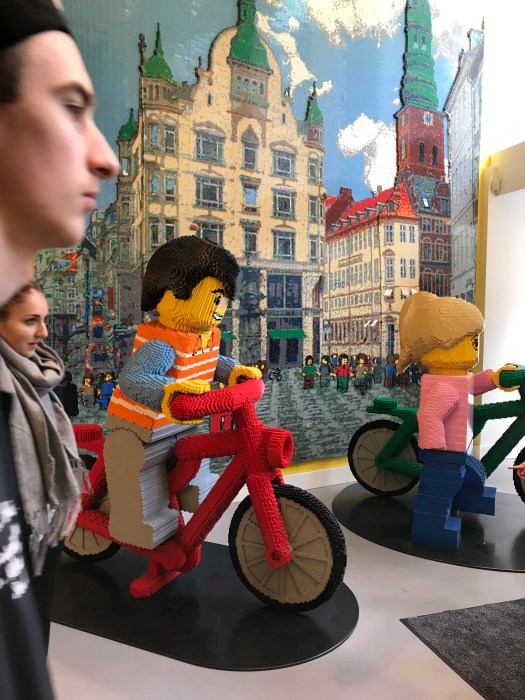
If you love Danish butter or cheese, you may take issue, but ask any kid and they’ll pick LEGOs out of a line-up and agree that this, more than any other claim to fame, puts Denmark on the map. The headquarters of The LEGO Group is in Billund; and there is a LEGOLAND a 6 hour bus ride from Copenhagen, also in Billund.
If you are only touching down in Copenhagen, there is a wonderful store dedicated to LEGO at Vimmelskaftet 37, on the main pedestrian shopping street. You can get or use a LEGO VIP card. You will find a great variety of LEGO toys. It is an energetic, happy place.
There is a saying in Denmark, “You learn best when you play.” Lucky for the rest of the world that LEGO founder Ole Kirk Christiansen took that and founded his toy company. If you love these colorful building blocks, you’ll thoroughly enjoy A LEGO Brickumentary.
If you have children or adults in your life who will be thrilled to receive LEGOs from DK, get thee to the store! Plus they are light to carry back.
I have to admit as an American I am not sure what I think of the idea of royalty. Does it have to more to offer than the USA’s celebrity culture, or is it much of a muchness? I was vaguely aware that Denmark has a royal family before I left for Copenhagen. I was not prepared for Mike Bike to get almost teary eyed when we stopped at her palace as he talked about the role she plays in his life.
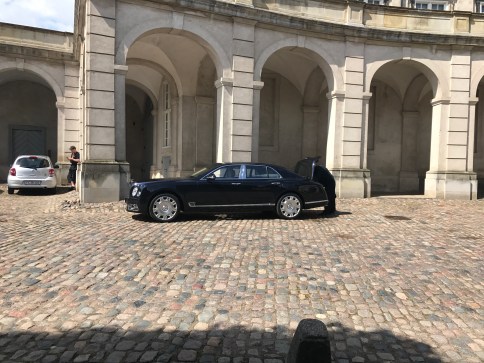
First when we stopped at the Christiansborg Palace on the bike tour, we watched the Queen’s groomsman exercising her carriage horses in preparation for an upcoming public celebration of her golden wedding anniversary. While we watched, one of the palace chauffeur’s stopped one of the royal family’s Bentley limousines for a few minutes. Mike Bike got very excited that the Queen or one of the princes might be in the car. No one was in the car, this time.
Then we moved on to another official building and Mike Bike said we should come back and see the tapestries that current Queen Margrethe II designed. She is apparently an accomplished artist. (We moved on before I could figure out exactly where we were.) Then as we came back from Christianshavn we stopped at the Queen’s Palace.
The Queen’s Guard was changing shifts and it was easy to find a spot in the courtyard to watch. The Danish changing of the guard is much more accessible but still displays the kind of tradition that people who live in countries with royalty seem to appreciate. The guards wear bearskin hats from Canadian bears. While the guard is changing you can only walk your bike in the courtyard. The flags flying over each palace–Queen, Prince 1, Prince 2, so that you know who is home and who is away. The band plays when the Queen is home.
Mike Bike explained that a particularly low point in his life he asked himself, “What would Queen Margrethe do?” He finds her wisdom and talents as a linguist and artist inspiring. She is married to her French husband Henri for 50 years and successfully raised two sons.
As we regathered after watching the guard change, we saw the same Bentley go by. We could see the Queen in the back seat and it was the same car we’d seen earlier. We all enjoyed the excitement, but none as much as Mike Bike. It is very endearing.
Thanks to Bike Mike, I had two great places to eat dinner and two nights available. The “Paper Island” is a warehouse filled with lots of street food. (A lot like the Portland street food but with a roof and lots of picnic tables.) And the other recommendation was for 108, a bistro started by noma alumni Kristian Baumann. The front desk staff at Absalom Hotel called 108. A table for one was available at 5 or 9 on either open evening. The restaurant also said they only take reservations for half their tables so I could try walking in at another time.
Noma shut in December 2016 so the team could reimagine the restaurant and menu in a new location. Meanwhile, 108 continued to serve up great food at a fraction of the price in a lively atmosphere at Strandgade 108. I am not a foodie, so I was a little nervous. It was the best food adventure I have experienced.
The wait staff worked as a team so I was never left long without something new to try and they all spoke English and were very interested in how I received each dish. They recommended I order three small savory dishes and one sweet. Then I also ordered a glass of bubbly and a cup of coffee with dessert. The couple next to me ordered two savory small plates plus a large plate to share (the monk fish), then after I gave them a bite of one of my dishes, they ordered it too. They also each ordered a different dessert to share. We were all enjoying the atmosphere and the tastes, each more incredible than the last.
I cannot do justice to the various dishes, except to say that I didn’t know that fresh, fresh peas and fresh, fresh caviar with rapeseed blossoms could taste so amazing. And that after eating the shaved truffles on the dumplings of braised pork, I thought I could smell truffle for the next 24 hours. All of this super adventurous eating and drinking for about $75 US.
At the opposite end of the cost curve was the street food, just down the way along the waterfront to a warehouse called “Paper Island” in English. I circled the various vendors twice and decided on the toasted sandwiches at Spoon. I asked the young man making my sandwich where he would recommend for fries. He said the best were at the place across the hall–the only place that fries them in duck fat. They were both delicious. I also bought a local beer at the “bar” in the middle that allows you to stay and dine at the tables while you go back and forth fetching more food. I also got a recommendation for a cheesecake place, Bertels, on the way home. My intention was to walk home and stop along the way, but the rain was lashing and I hailed a cab once I crossed the pedestrian bridge.
Mike’s recommendations were both super. So you may also want to try one of the traditional Danish restaurants known for smorresbord, but only if open-faced pickled herring sandwiches chased with a shot of schnapps (snaps) sounds divine. It sounds like a fast track to a nap to me!
Mike’s other recommendation was to rent a bike and cycle to both Paper Island or 108. This is a very good idea because it is a long way to walk and the taxi ride is about $30 from the central station. Remember rush hour starts early in Copenhagen as most people begin their commute home between 4 and 5 p.m.
I arrived late on a Monday night and then I took the train early to Malmo, Sweden on Tuesday, so my first full day in Copenhagen was Wednesday and I had not yet seen anything besides the train station and a pastry shop. I had reserved a spot with BikeMike Tours after hearing about it from Rick Steves. After witnessing just a little of the bike traffic, I was glad I booked a tour and would have a guide for my first foray into the city.
Copenhagen is a 1000 years old and committed to keeping their streets cobbled and their footprint much the same. It was not designed for cars. Yet it is a dynamic, economically vibrant place. Bicycles allow them to move people without sacrificing the quality of life that their history offers. The cycling culture is such that people ride everywhere in all weather and with cargo bikes if they have children or a load. As one fellow tour rider from the USA noted, “No one is wearing lycra bike shorts or riding a fancy bike.” It is part of the fabric of life and very utilitarian.
I digress, I want to tell you about this fabulous tour.
Mike is a bit gruff when you first meet him at the shop. His website can also be offputting to some:
i am not just another #$@%&*! bike tour guide. I am bike mike.
I appreciated that he was being very forthright about what his tour was and was not. What it is: an exciting tour of the city at a good pace with a guide who LOVES Copenhagen and Denmark. I ride my bike as my main source of transportation and I “kissed” the curb; my bike went down but thankfully I did not. So the city cobbles and curbs can be challenging especially to riders from the USA. It is so worth the risk.
I arrived feeling very jet-lagged and hoped that the fresh air and exercise would revive me. There were about 18 of us in the group with a mix of Europeans and Americans. Mike leads the way and expects you to follow, and we did. People in my group did a great job of keeping up.
Mike does stop often to share information about this beautiful city and its culture. He is unabashedly proud of their socialist welfare state and the monarchy. He is a real enthusiast and he will infect you with a love of Copenhagen.
He also gave good tips on restaurants along the way. Although his description of a typical Danish lunch–open faced sandwiches of pickled herring followed by a shot of snaps (schnapps)–sounded like a fast track to a nap!
He said we would ride through whatever weather came our way just like a local. However, when a particularly nasty bit of rain and wind came through he let us grab a coffee at the national theater and then ride on. This added an hour to our tour but no one complained.
In fact, we were all full of good will toward one another at the end. The tour was well worth the DKK 299 in cash.
I also learned about these really groovy Danish locks that fit onto your bike as a permanent fixture. Mike uses them as do most people in Copenhagen. I walked across the street to the bike shop and bought 2 to use at home.
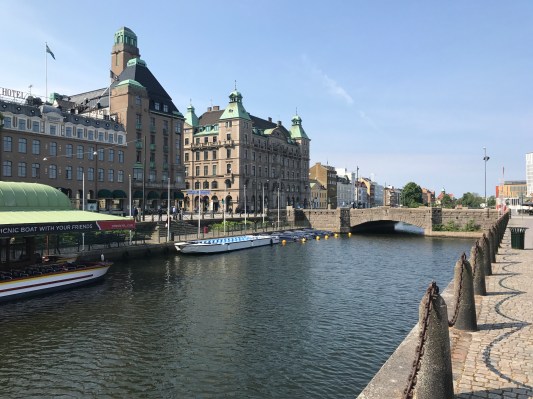
The view from the steps of the Central Station in Malmo.
One of the attractions of Copenhagen is that it is a just a long bridge away from Malmo, Sweden, and my college chum Susie lives in Malmo. I was able to spend the with her on a Swedish national holiday.
Susie met me at the train station and we hopped on the number 7 bus and see more of the city. She was hoping that we could take the river cruise but it was not operating at 10:30 a.m. on this holiday. We rode along manicured boulevards with beaches just over the rise. We hopped off at an island called “Island.”
Turning Torso or as I call it, Twisted Sister
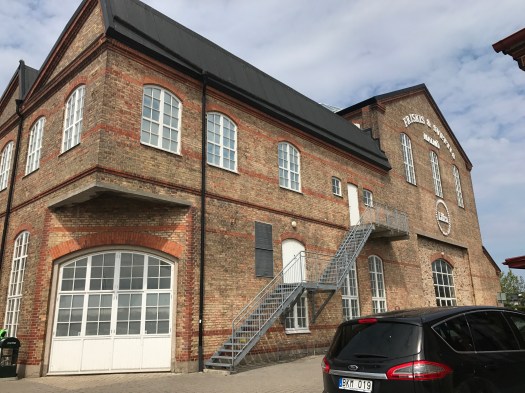
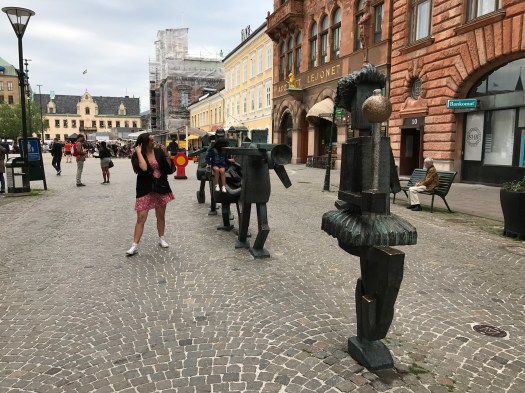
We walked along the sea and admired the mixed income neighborhood and mix of old and new. The gym and cafe and market are located in a brick building that had been Hermann Goring’s airplane factory between WWI and WWII. Sweden was neutral and so they have lots of ties to Germany AND they allowed thousands of Jews to move from Denmark to safety in Sweden.
Three buildings in downtown showing the many ages/phases of Malmo.
We then rode the bus into a “new” development (by Swedish standards) on an old infill site that had been a shipbuilding yard. In the mid-1980s the company stopped building ships and sold off its assets. The area was redeveloped and continues to grow and change. The iconic building the Turning Torso (designed by a Spanish woman architect) is also located here as the one skyscraper in the neighborhood.
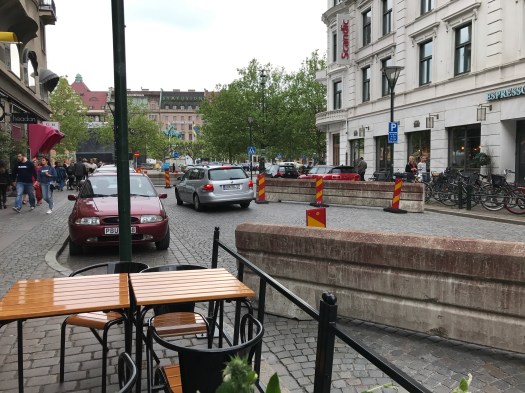
A brilliant idea for thwarting terrorist attacks on the city’s celebration.
We walked to a cafe called V.E.S.P.A. for salad and pasta. It was yummy. One of our servers was an expat from Minnesota. We talked and talked for 2.5 hours! By then we were ready to walk on and find gelato. It is generally windy in Malmo but it was particularly blowey this day. We jumped on the bus one last time to return to the train station. We walked into the center square of the old city.
Hermann Goring’s factory
Lots of businesses were closed for the holiday and the city had a special program planned. We had a little time before it started so we continued our walking tour. Swedish flags were flying in many places as it was a “red letter day,” one of days when it people are allowed to fly the national flag.
The national church is Lutheran and there is no separation of state. Unless you declare yourself a non-believer and take action to separate yourself, 3% of your income tax will go to support the church. Devout Christians account for 29% of the population, but almost everyone is a member and most teams participate in confirmation as a rite of passage.
St Peter’s Cathedral is a lovely and inspiring. Susie said she and her husband John enjoyed a worship service where the pastor read scripture and invited people to meditate while the organist played Bach on the pipe organ. They loved it.
We watched the Fire Department band play and a goofy rhythmic gymnastic group perform an anachronistic routine that felt like 1950 not 2017. They juggled red balls and did mild calisthenics without breaking a sweat. They inspired us to giggle and marvel that this troupe still attracts participants.
We retired to Susie’s gracious apartment and enjoyed a home cooked meal. Her husband John, and her daughters Linnea and Olivia answered questions about “cozy time” and other uniquely Swedish things.
It was a quick 45 minute train ride back to Copenhagen. It made a great day trip.

 I bought the NBC Sports Gold pass for cycling during the Tour of California in May. It did not include the Giro but it will include the Tour de France. I watch on my computer, follow VeloNews and the @letour on Twitter and watch every episode of Orica Scott Backstage Pass on YouTube.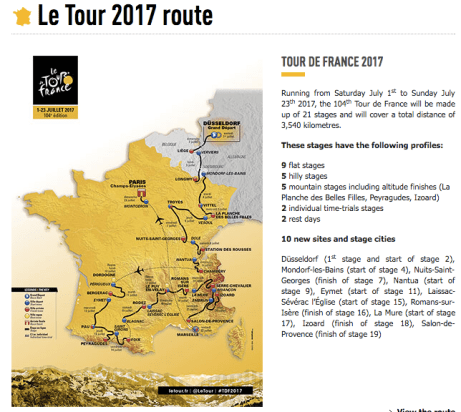

 Wiking is the head of the Happiness Research Institute in Copenhagen where he studies living well. I learned quite a few things about hygge from his book. First, unscented candles are critical to creating hygge, best translated in English as “cozy togetherness” Most Danes use lots of candles, lots of sweets and lots of ham and bacon, washed down with coffee or hot chocolate. The ideal number of people to enjoy this cozy time is 3-4 so it is perfect for introverts. The dress code is comfy/casual and often everyone watches “box sets” (think binge watching on Netflix) or plays board games.
 It did seem odd that the name of the most visited art museum in Denmark is called the
  The train takes you to within a 10 minute walk of the Museum. The museum has a permanent collection both indoor and out, plus 2 special exhibits. When I visited I was able to view the retrospective for Danish artist Tal R and a fascinating exhibit of South African artist William Kentridge. I was disappointed because the Marina Abramovic exhibit was due to open the following Saturday, but then I’d have missed Kentridge. (I know, first world problems.)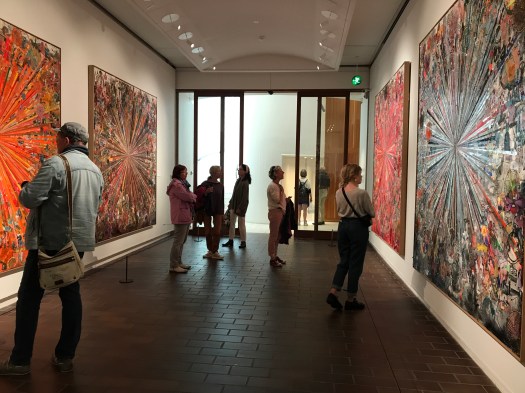


 If you love Danish butter or cheese, you may take issue, but ask any kid and they’ll pick LEGOs out of a line-up and agree that this, more than any other claim to fame, puts Denmark on the map. The headquarters of
 I have to admit as an American I am not sure what I think of the idea of royalty. Does it have to more to offer than the USA’s celebrity culture, or is it much of a muchness? I was vaguely aware that Denmark has a royal family before I left for Copenhagen. I was not prepared for Mike Bike to get almost teary eyed when we stopped at her palace as he talked about the role she plays in his life.

 Mike Bike explained that a particularly low point in his life he asked himself, “What would Queen Margrethe do?” He finds her wisdom and talents as a linguist and artist inspiring. She is married to her French husband Henri for 50 years and successfully raised two sons.


 At the opposite end of the cost curve was the street food, just down the way along the waterfront to a warehouse called “Paper Island” in English. I circled the various vendors twice and decided on the toasted sandwiches at Spoon. I asked the young man making my sandwich where he would recommend for fries. He said the best were at the place across the hall–the only place that fries them in duck fat. They were both delicious. I also bought a local beer at the “bar” in the middle that allows you to stay and dine at the tables while you go back and forth fetching more food. I also got a recommendation for a cheesecake place, Bertels, on the way home. My intention was to walk home and stop along the way, but the rain was lashing and I hailed a cab once I crossed the pedestrian bridge.




 St Peter’s Cathedral is a lovely and inspiring. Susie said she and her husband John enjoyed a worship service where the pastor read scripture and invited people to meditate while the organist played Bach on the pipe organ. They loved it.
 americanjulie.com