

While Montgomery and Selma seem stuck in the past, Birmingham is positively forward facing with a robust economy. Birmingham experienced significant civil rights related strife in 1963, including the Children’s Crusade. The downtown is in the beginning of a renaissance and the Civil Rights scars appear to be healing. We started our Sunday at church.
 After worship we sought sustenance in the form of brunch. One of the parishioners recommended a restaurant and we walked several blocks only to read the notice that it is permanently closed. The sign suggested we try Mr. Z’s Take Away. We went off in pursuit and ended up deciding to dine at Roots & Revelry, a newish restaurant in a bank redone as apartments and cafes. My chicken and waffles was divine. I’ve added a rule, besides trying pie whenever the opportunity presents, I am going to try fried chicken when in the South and it is on the menu.


My friend made the mistake of wearing fashionable shoes and we’d done a lot of walking already. We were determined to visit the Civil Rights Institute and Kelly Ingram Park was just alongside both the church and Institute. Ingram Park has most of the stops along the Freedom Walk. There are multiple moving statues that tell the story of the Children’s Crusade. Even with the visual aids it was hard to imagine turning fire hoses and dogs on young children (until the recent tear gas at the border on women and children seeking asylum). Some things change and some things stay the same.


When we saw for ourselves the Sixteenth Street Baptist Church location at one corner of the park, we could better understand how it was used by the children as sanctuary and then how it became a target. This is the church that was bombed resulting in the death of four young girls.
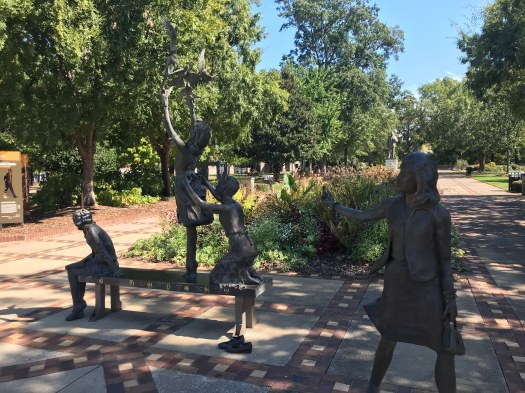
Sometimes when I am sitting towards the back of our big sanctuary in Sacramento, I think of how safe I think I am–how little I worry about someone with violent intent coming into our midst. This is a luxury of a mostly Scandinavian Lutheran congregation. With the Charleston shooting, and church burnings, and then more recently the Pittsburgh synagogue shooting, I begin to understand what a violation it is to attack a “sanctuary”–a place where we go to worship God and fellowship, a place were strangers are made welcome. The events of 1963 are still relevant.


We did arrive in time to visit the Civil Rights Institute. It offers a comprehensive timeline of the Civil Rights movement. I wished this was our first stop instead of the last on our crawl. We spent quite a long time reading the exhibits and left just before the museum closed. The sidewalks were starting to roll up, so we made our way to the hotel.




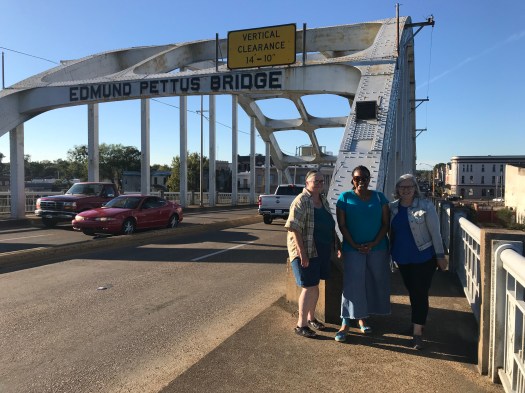 We were able to walk across the Edmund Pettus Bridge and imagine what it must have been like to reach the peak of the bridge, high above the Alabama River, and face a sea of mounted police and police cars with blue lights flashing. I was energized by a group of high school students who started their walk with us but quickly outstripped us. We’d see them again at Brown Chapel. We also spoke with some fellow travelers—a group of friends from Texas and New York–who met up in Alabama. They recommended we also see the Old Live Oak Cemetery.

 The contrast of the large lawns and stately homes near the cemetery with the George Washington Carver apartment complex across the Brown Chapel AME Church is stark. We pulled up to the church as the high school students were leaving and Chantay spotted the church pastor. She spoke to him and enjoyed a tour of the sanctuary while Phyllis and I admired the Martin Luther King, Jr. monument. The pastor was very generous with his time and gave Chantay commemorative key chains to share with us.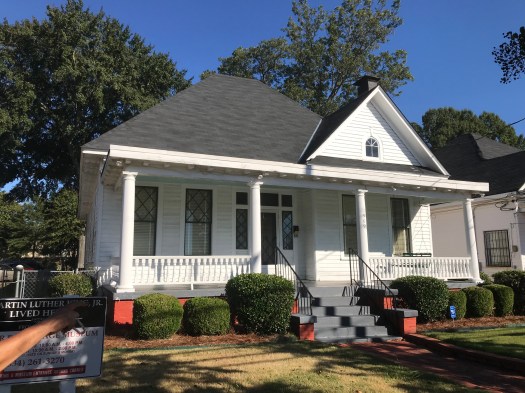


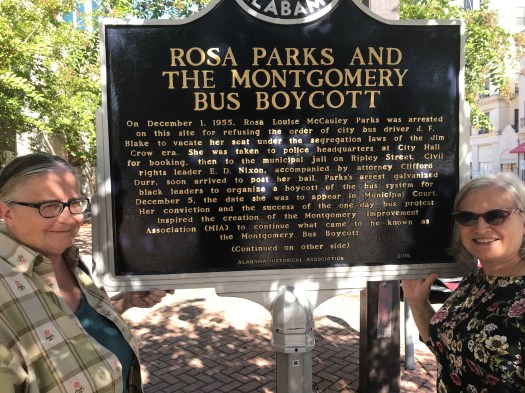
 Our group was ushered in to the first room where we watched a video giving us more information about Rosa Parks. Many know her story in the most simplistic terms: woman is tired of the segregated city bus policies and one day refuses to give up her seat. The reaction from her community sparks the civil rights movement. This is true is in its essentials and glosses over a lot of important details. The video begins to redress the gaps. Our esteem of this diminutive hero increased.


 The only way to end the legacy of domestic terrorism is to remember, confront our part, and learn. The
  The Legacy Museum gives more detail and a timeline of the lynchings. Through a multi-media presentation of historical accounts of lynchings, the Legacy Museum carries the story through to the new method of terror, mass incarceration.
 americanjulie.com