

Driving through Alabama, I came to a renewed appreciation of small towns. So many of the town squares and courthouses reminded me of some of my favorite Iowa small towns. People who live in small towns are often underestimated or overlooked. The history of the civil rights movement has deep roots in rural places.
The March from Selma to Montgomery has its roots in Marion, Alabama. Jimmie Lee Jackson was shot in Marion by a state trooper during a peaceful protest for voter rights on February 18, 1965. This prompted the first attempt at a peaceful march from Selma to Montgomery on March 7, 1965. Reverend Hosea Williams and John Lewis stepped from the pulpit of Brown Chapel Church and led 600 marchers six blocks to the Edmund Pettus Bridge where the Sheriff and mounted deputies met them with nightsticks and tear gas. Known as “Bloody Sunday” it sparked the expanded civil rights movement in Alabama.

We drove to Marion, Alabama on beautiful country roads. Marion, the college city, is only 28 miles away and is the county seat for Perry County. As a Californian, it is odd to have so many small counties, each with their own courthouse on a square, although it is charming architecturally. We were visiting my friend Dr. John Dorsey in Greensboro, Alabama. We needed an accessible accommodation, so we reserved rooms at the Sleep Inn in Marion. Greensboro is so small the only sleep options are bed and breakfasts and AirBnB.
Marion is also the home of the Marion Military Institute and Judson College, so it is nicknamed, “College City.” The Marion Military Institute has been preparing young men for college and military service for over 165 years. Judson College was originally a “ladies college” or finishing school and has evolved into a liberal arts college. The town of Marion is a classic southern county seat with a courthouse in the middle of a gracious town square. Marion can also claim Coretta Scott King as one of their own.
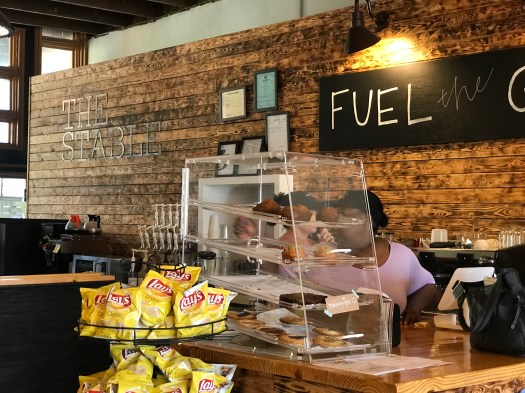


It was a home game for Alabama so Greensboro had many people driving through from Mobile and stopping at the Pie Lab. My friend Dr. John Dorsey arrived in Greensboro 13 years ago and the downtown was almost empty. He came to serve as a psychiatrist in a rural community and try some ideas about affordable homes with supportive services in a lower cost area. Project Horseshoe Farm has grown and the 15 fellows that are living and working in the community, along with the Rural Studio students created an economic spark and now there is a gym, The Stable coffeehouse, Pie Lab, several retail shops, and more.

Hale County, just 10 miles down the road from Greensboro, is the home of Auburn University’s School of Architecture Rural Studio. The students are required to design, fundraise, and build their final project. Many of their projects are in Hale County or in Greensboro. It is world-renowned and a terrific resource in the Black Belt of Alabama.


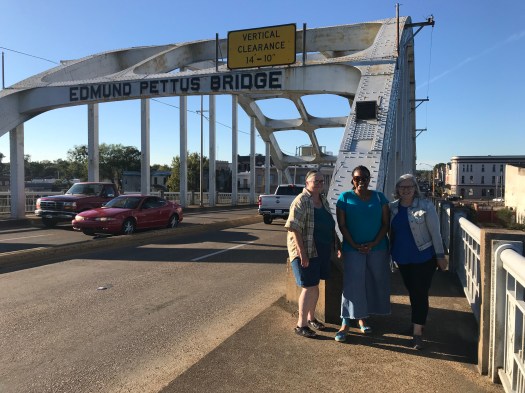 We were able to walk across the Edmund Pettus Bridge and imagine what it must have been like to reach the peak of the bridge, high above the Alabama River, and face a sea of mounted police and police cars with blue lights flashing. I was energized by a group of high school students who started their walk with us but quickly outstripped us. We’d see them again at Brown Chapel. We also spoke with some fellow travelers—a group of friends from Texas and New York–who met up in Alabama. They recommended we also see the Old Live Oak Cemetery.

 The contrast of the large lawns and stately homes near the cemetery with the George Washington Carver apartment complex across the Brown Chapel AME Church is stark. We pulled up to the church as the high school students were leaving and Chantay spotted the church pastor. She spoke to him and enjoyed a tour of the sanctuary while Phyllis and I admired the Martin Luther King, Jr. monument. The pastor was very generous with his time and gave Chantay commemorative key chains to share with us.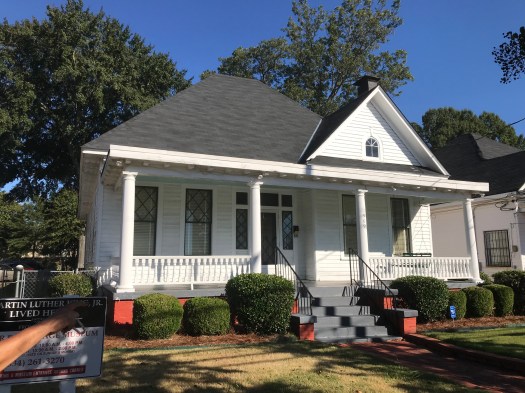


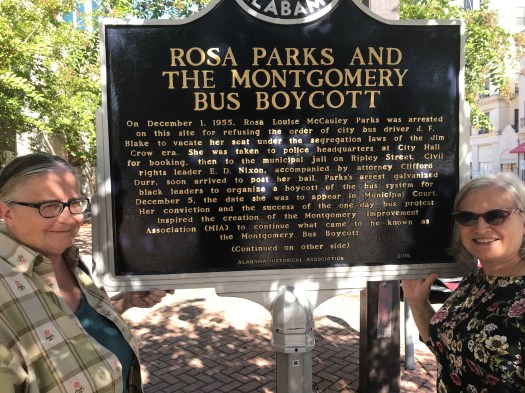
 Our group was ushered in to the first room where we watched a video giving us more information about Rosa Parks. Many know her story in the most simplistic terms: woman is tired of the segregated city bus policies and one day refuses to give up her seat. The reaction from her community sparks the civil rights movement. This is true is in its essentials and glosses over a lot of important details. The video begins to redress the gaps. Our esteem of this diminutive hero increased.


 The only way to end the legacy of domestic terrorism is to remember, confront our part, and learn. The
  The Legacy Museum gives more detail and a timeline of the lynchings. Through a multi-media presentation of historical accounts of lynchings, the Legacy Museum carries the story through to the new method of terror, mass incarceration.
 americanjulie.com